





KATHMANDU: A group of North Korean hackers has remained surreptitiously active in operating cyber espionage from Apartment No 16 ‘A’ of the Harmony Housing at Tokha, around five kilometers north of Kathmandu’s Basundhara (Ringroad), especially targeting banking and financial institutions across the world. This was revealed through investigations by Khabarhub for months. The Harmony Housing, away from the hustle and bustle of Kathmandu, has a total of 11 buildings.
The group, comprising of six members — identified as Song Hyok Peak, Jong Gon Choe, Jin Hyok Pae, Phyong Yun, Yong Guk Kim, and Jong Nam Won – stationed at the apartment are active throughout the clock to work for North’s army intelligence agency. Amassing money from various countries is a major part of its spying activities, it is learned. However, according to a security guard at the apartment, another five people are seen on and off.
Evidences obtained by Khabarhub’s two-month-long investigation with the support of computer experts reveal that the group has been found to be directly working for the 121 Bureau of the seven different intelligence bureaus under Section 586 of the North Korean Directorate General of Military Intelligence, which is also known as the Lazarus group or Hidden Cobra.
These hackers are found to be judiciously routing their signal through Virtual Private Network (VPN) from Singapore, India, Germany, South Korea and Taiwan to setup their server to shroud their presence in Nepal.
The group active in Nepal is also found to be creating dozens of internet addresses, including some IP addresses in the name of hospitals, charity firms, schools and other institutions, according to high-placed security sources.
They not only use common hacking techniques from Nepal like phishing, click jacking DDoS, but also make malicious software and malware programs like Virus or Trojans, worms, to infect damage financial, and others targets.
The North Korean hackers mostly use eavesdropping tactics that passively monitors the targeted computer systems to obtain secret technical information. The main motive of this shadowy hacker group in Nepal is to collect money for the North Korean government, evidences show.

The country, which is reeling under crippling sanctions imposed by several countries and international organizations, including the UN, apparently operates cyber espionage and hacking through the gang under a company named ‘Yong Bong Chand IT Company Pvt. Ltd’ registered on January 14, 2018, in Nepal.
However, the Government of Nepal seems indifferent to such activities operating under a false-flag company, which has been taking place in collaboration with Dharma Chand, a Nepali national. Record, however, shows that the company’s address is in Thapathali area.
It should be noted that the UN Security Council Resolution 2375 prohibits North Korean individuals and entities in activities such as opening, maintenance, and operation of all joint ventures or cooperative entities, new and existing whether or not acting for or on behalf of the government of North Korea, unless such joint ventures or cooperative entities, in particular those that are non-commercial, public utility infrastructure projects not generating profit, have been approved by the Committee in advance on a case-by-case basis.
Meanwhile, efforts to reach Chand’s office landline number (01-410…3) and cell number (984…8181) could not materialize since his employee informed that he was “out of station” while his cell was “switched off”.
Nepal’s Labor Department, however, has not issued the labor permission to the group of six and the other five, who, reports suggests, came to Nepal on tourist visa.
According to the data at the Department of Industry, the company promising to employ at least 55 people during its registration process, had sought 170-package data for ‘software development’.
North Korea, which has been banned by the UN Security Council from obtaining labor permit, had initially sought labor permission from Nepal cataloging it as a South Korean company to ‘install’ its hacking operation here. However, according to the evidence obtained by Khabarhub, the company was registered with the support of two incumbent ministers defying the Nepal’s international obligation and commitment.
Besides hacking, the company is involved in trading of software and money laundering activities through ‘dark web’. Similarly, North Korean diplomats, who are in regular touch with these hackers, have been funneling money to North Korea.
Retired Nepal Army General Binoj Bansyat told Khabarhub that North Koreans have been using the Nepali soil for such activities. “This will send a negative message to the world,” he said adding that Nepal’s intelligence should be further strengthened.
It has also been revealed that two of the six members frequently visit their home country, North Korea, acting as a bridge between the North Korean officials and the group. These two people receive hacking targets and instructions from their seniors and convey to the team.
“It is in fact reprehensible that North Korean hackers are clandestinely involved in illegal activities such as hacking, depositing a huge amount of money, and spying from the Nepali soil,” former CIB Chief Hemant Malla said.
“They have been actively involved in unlawful activities, including hacking servers of banks and financial institutions and spying against western countries from Nepal for quite a long time by taking due advantage of Nepal’s weak security mechanism,” he added.
Interestingly, while the Nepali partner holds 20 percent share of the Yong Bong Chand IT Company Pvt. Ltd, the North Koreans hold the rest 80 percent share with the company having a total of Rs 100 million as gross capital, around 8.90 million as fixed capital, and Rs 10.9 million as working capital.

Locals of Tokha area are unacquainted about the group’s activities since the hackers usually keep a low profile. They hardly come out of the house during the day to avoid public attention. However, they frequently visit the North Korean Embassy at Bukhundol in Lalitpur during the night while North Korean diplomats use a taxi instead of diplomatic vehicles to visit the Tokha-based apartment.
Investigations have revealed that two employees of the North Korean Embassy make available all necessary supplies, including food items, to the hackers either early in the morning or late night when everyone around is asleep.
These hackers use several SIM cards from various data package, which have been obtained in the name of some Nepalis, to use the internet, which means that they are carrying out their activities surreptitiously to avoid the fear of being detected.
“Several North Koreans coming to Nepal on a tourist visa, are found to be involved in unlawful activities. However, the government has to bring such elements to book while keeping its security organs effective,” opined Devi Ram Sharma, former Chief of National Intelligence Department of Nepal adding that the government has failed to carry out its surveillance, detect and arrest on such activities. “Nepal should abide by the international commitments on such issues,” he added.
Meanwhile, geo-strategist expert, Arun Subedi termed the issue as ‘serious’ while stating that it is unfortunate that some elements are trying to use the Nepali soil against Nepal’s neighbor and other friendly countries.
“This is, in fact, unfortunate,” Subedi said while suggesting the government to take immediate action to thwart such activities.
He was categorical to state that North Korea, which is facing strict UN sanctions and reeling under severe economic crisis, has been using its embassy here in such illegal activities to generate money through diplomatic cover.
Lazarus eyes on banks
The Lazarus hacker’s group, run by the North Korean army intelligence, funnels billions of money to North Korea after hacking from different countries. South Asia, including Nepal, is becoming the group’s recent target. This group had earlier hacked Rs. 460 million from NIC Asia Bank in 2017.
“We will look into the NIC issue,” Spokesperson of Nepal Police, Uttam Raj Subedi told Khabarhub adding that the police will further investigate the alleged involvement of North Koreans in cyber hacking from its Kathmandu base.
Accepting the fact that new techniques are being used in cybercrimes in recent times, he said a cybercrime investigation bureau has been formed to look into such issues. He informed that the department has been constantly in touch with the government to procure additional equipment and a forensic lab for the purpose.
In three days, between August 11-13, 2018, the North Korean group had managed to siphon IRs 940 million through a malware attack on the server of the Pune-based Cosmos Bank in India. Hackers also cloned several of the bank’s debit cards in just over two days. Despite being alerted by the Federal Bureau of Investigation (FBI), the group stole such a huge amount.
In 2016, the same group had also hacked and transferred over Rs. 85,000 million to various banks across the globe from the Center Bank of Bangladesh.
Towards its inception, the notorious Lazarus group had terrorized South Korea through cyber-attacks. However, it was the group’s attack on Sony Pictures of Sony Company in 2014 that ramified the group’s terror at a global scale. This was because the group had used sophisticated technology in the attack. It then attacked Del Austro, a bank in Ecuador incurring a loss of over US$12 million to the bank.
Similarly, the group also hacked from US$ one million from a bank in Vietnam. Likewise, the group hacked US$ 60 million from the East International Bank in Taiwan in 2017.
Stealing of money through hacking by the group has terrorized banking industry in Nepal, India, and Bangladesh. North Korea has resorted to amassing money through hacking as it faces resource crunch due to the strict sanction imposed by the USA and the UN.
The Lazarus Group earlier attacked financial institutions in several countries such as Ethiopia, Costa Rica, India, Gabon, Iraq, Indonesia, Kenya, Poland, Malaysia, Nigeria, Thailand, Taiwan, and Uruguay, according to reports.
Nepal at high risk
Given the hacking record of the group and its hacking business, bank and financial institutions in Nepal are highly vulnerable to the group. This is more so as the hacker groups are operating from Nepal. Besides, financial institutions have remained largely indifferent to the mandatory ruling by the Nepal Rastra Bank (NRB) for cybersecurity audits.
“Foreign hackers operating from Nepali territory is a matter of grave concern and could prove very costly to the country,” opines Dr. Suresh Chalise, former diplomat adding that this will draw the attention of the international community.
Meanwhile, analysts warn that the government must address the cybersecurity issue to avoid a disaster in the banking as well as other sectors.
The hackers shifted their base to Nepal after intense international monitor and crippling UN sanction to control its bad behaviors as well as nuclear and missile ambitions.
KATHMANDU: Reaching atop the Everest can be a lifelong dream for an adventurer. In fact, a substantial number of tourists visit this Himalayan country, Nepal, with a long-cherished dream of ascending the Mt. Everest, the world’s highest peak.
So far, more than 9,000 people have successfully conquered the world’s highest summit after Tenzing Norgay Sherpa and Edmund Hillary set their feet atop the summit, 8,848 meters, on May 29, 1953.
“Oh, in fact, I have no words to describe the feeling when I reached atop the Everest at the age of 19,” a cheerful Mingma recalls the ‘joyous’ moment.
Every year, Mount Everest attracts scores of audacious travelers and mountaineers, who believe reaching the top of the world is something more than finding the Holy Grail despite all odds. They risk avalanches, storms, ‘death zones’ and harsh temperatures in an attempt to summit the peak.
The success rate of climbing the mountain is getting high, due to the experienced Sherpas who have spent several years in the mountains, claims Mingma Gyabu Sherpa, a guide.
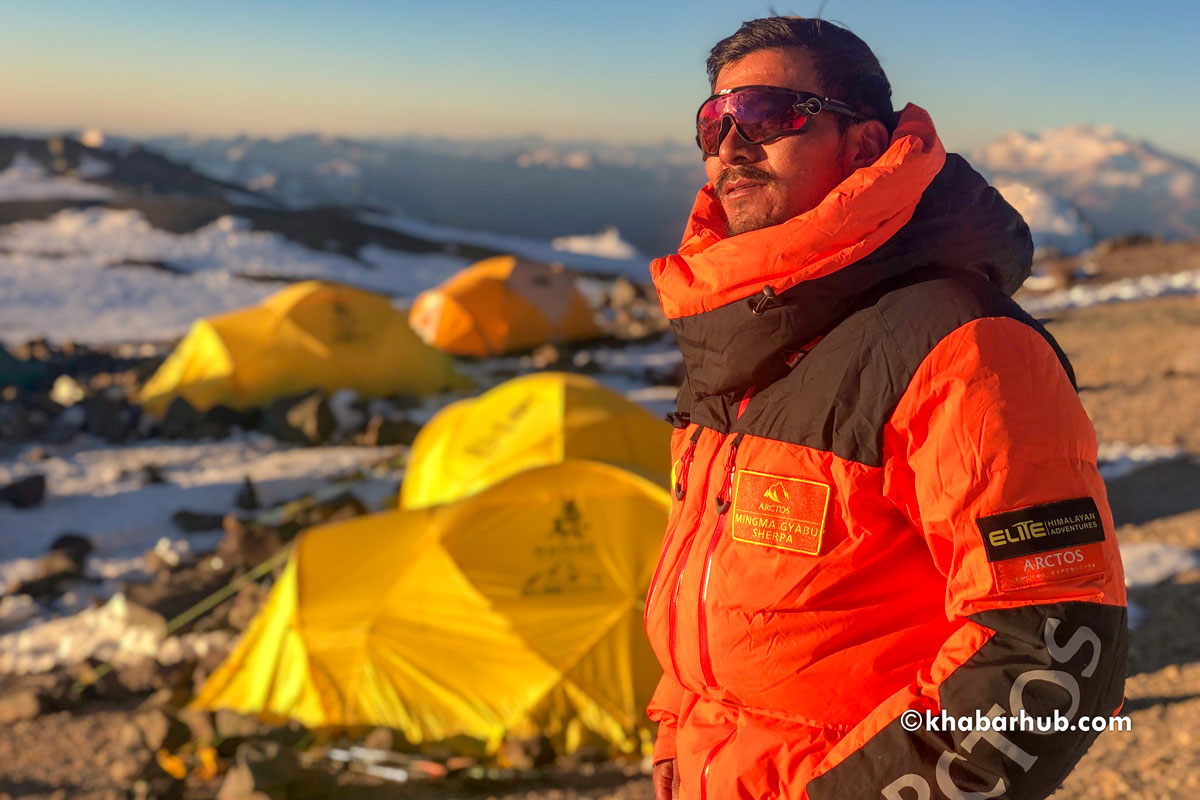
Born on May 16, 1989, in Taplejung, Mingma started his career as a porter in 2009. Full of enthusiasm and confidence, Mingma set on a mission to ascend the Everest in 2010 and succeeded in reaching the top of the world.
Talking with Khabarhub, Mingma recalled one of his neighbors, Dorje Khatri (died in 2014 due to the avalanche at Everest Base Camp), who encouraged him to climb the peak. “In fact, Khatri boosted my confidence,” Mingma said while recalling what Khatri had told him once: “Never look back”. In fact, Mingma never looked back. His only aim was to conquer the world’s tallest peak. And, he did it!
He, however, appealed to the government to categorize mountaineering guides and provide them with social security.
“Oh, in fact, I have no words to describe the feeling when I reached atop the Everest at the age of 19,” a cheerful Mingma recalls the ‘joyous’ moment.
Sharing what goes inside a mountaineer after conquering a peak, he said that summiteers become speechless for a moment. “You can’t express the moment once you set your feet there,” he quips.
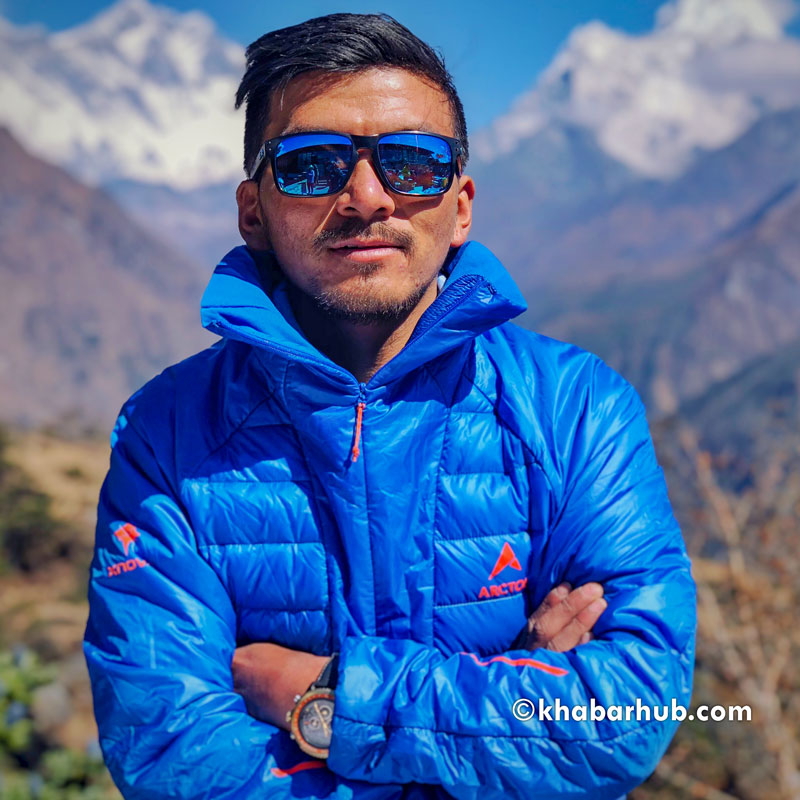
It was in 2016 when Mingma, along with a team of five Sherpas, organized a rescue operation at the height of 8,600 meters of the Everest. He reminisces the moment when after three unceasing hours of struggle, they found two climbers — Chetana Sahu, 43, from Odisha’s Cuttack district in India and Phurba Sherpa – who were struggling for life.
“Both of them were in a critical condition with their supplementary oxygen running out. We safely took them to the South Col, the sharp-edged col between Mount Everest and Lhotse. They were so gratified that they told us we gave them a new life,” Mingma recalls those moments with pride.
In the course of time, Mingma was honored with Piolets d’Or Asia Awards under the Sherpa category for his commitment to technical face climbing and positive environmental stewardship in the mountains. The award aims to encourage and inspire Asian mountaineers who achieved pure and visionary ascents. With the award, he was recognized as the Sherpa of the Year 2019.
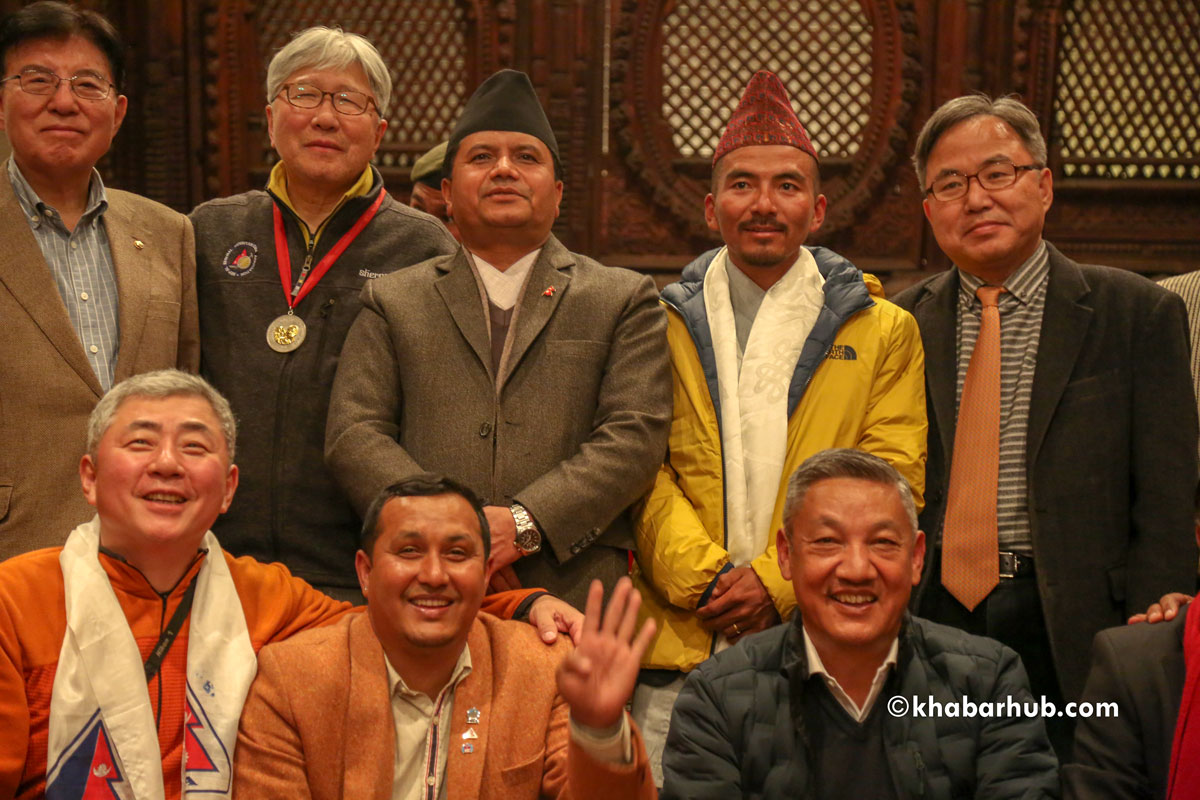
“There was no incident that made me look back or quit mountaineering. It was my dream and I have succeeded in all attempts I have so far made,” a contented Mingma told Khabarhub.
He, however, appealed to the government to categorize mountaineering guides and provide them with social security.
Mingma, however, is worried about the difficulties in climbing the Everest in recent times. “In fact, climbing the Everest has become tougher due to global warming,” he said, adding, “The Khumbu Icefall is melting faster due to global warming. Despite this, the climbing seems easy due to experienced guides and sophisticated equipment they use,” he shared.
Mingma claims that he is not climbing the mountains for records. His dream is to climb successfully 14 peaks and 7 summits.
In 2017, a British Gurkha soldier, Hari Budha Magar, who lost both his legs in Afghanistan, scripted history by successfully standing atop Mera Peak (6,476m) in the autumn climbing season. Magar became the first double amputee above the knee to climb the country’s highest trekking peak in the autumn season. Mingma had led Magar successfully to the peak.

Mingma says foreigners climb the mountains because of their interest, as well as to set a record. Mountaineers reply on the courageous Sherpas while climbing the Everest.
In the current year, Mingma successfully climbed Island Peak and is on the way to climb Mt. Annapurna (8,091m). He will then climb Mt. Dhaulagiri (8,167m), and Mt. Kanchanjunga (8,586m) in the same season. Likewise, he is also planning to climb four mountains of Pakistan.
Mingma claims that he is not climbing the mountains for records. His dream is to climb successfully 14 peaks and 7 summits.
KATHMANDU: In Nepal, the number of children missing has been increasing every year. Among the missing children, most of them are between the age group of 10-15 years.
As per the record maintained by the Children Search Coordination Centre, Kathmandu, a total of 2,210 children went missing from different parts of the country in the last eight months of the current fiscal year. Among them, 1,050 have been found while whereabouts 1,160 were still unknown.
Experts say most of the children go missing within the country. According to the center, 43 children were rescued from different parts of India in the past year. More girls go missing than boys.
Records paint a grim picture for the earlier fiscal year too. Some 2,330 children went missing in the fiscal year 2017/18. Among them, only 1,017 were found and whereabouts of 1,313 were still unknown. It shows that the number of children found is relatively low.
According to Police Inspector Mohan Bikram Dahal, 72 percent of kids missing from Kathmandu Valley are found. Meanwhile, 22 percent of children missing throughout the country are found.
Experts say most of the children go missing within the country. According to the center, 43 children were rescued from different parts of India in the past year. More girls go missing than boys.
It has been found that most children leave home due to tension within the family while others due to peer pressure. A second marriage by parents and peer pressure, among others, have been the reasons for deserting home, as stated by the children, who have been found.
It has been found that middleman forces them to work as domestic helpers. Such children are subjected to sexual exploitation.
“Wrong use of social media has been one of the major reasons for the incidences. They desert their homes due to immature relationship and attraction toward urban lifestyle,’ said Inspector Dahal. He adds most of the missing kids suffer sexual exploitation.
According to Children Search Coordination Centre, most of the missing children hail from poor families of Nuwakot, Kavrepalanchowk, Sindhupalchowk, Rautahat, and Rukum, among other districts.
It has been found that middleman forces them to work as domestic helpers. Such children are subjected to sexual exploitation.
Two years ago, The Sun, a tabloid newspaper published in the United Kingdom, had revealed that children from the earthquake-affected areas in Nepal are being trafficked to Britain. It was also reported that the trafficked kids were deployed as domestic helpers. The tabloid exposed that a Nepali child was sold at a rate up to 5,250-pound sterling.
Children are the future of the country and it’s the duty of the government to shape them as a capable citizen through effective education. Although the number of children missing is increasing each year, the Ministry of Women, Children and Senior Citizen has not taken any effective steps. Observers say it is indeed a sad state of affairs.
Fiscal years |
Missing |
Found |
Whereabouts unknown |
2014/15 |
786 |
309 |
477 |
2015/16 |
1502 |
408 |
1094 |
2016/17 |
2772 |
720 |
2052 |
2017/18 |
2330 |
1017 |
1313 |
Eight months of current fiscal year |
2210 |
1050 |
1160 |
Source: Children Search Coordination Centre, Kathmandu
KATHMANDU: Sometimes, records are made unknowingly. This happened in the life of Phurba Tenjing Sherpa – a proud recipient of two Guinness World Records.
On May 23, 2018, he climbed Mt. Everest with his siblings — Pemba Dorje Sherpa, Dawa Diki Sherpa, Phurba Thinley Sherpa – to set a record of the most number of siblings to ascend Mt. Everest concurrently. Did Phurba know that he was making a record by climbing with his siblings at the same time? “No, I only realized it later that we set a record,” he quips.
Born in 1988 at Rolwaling village in Dolakha, Phurba Tenjing started making a living as a porter at the age of 14. So far, he has guided a total of 23 Nepalis and a sizable foreigners to the peaks.
This young Sherpa also holds the record of ‘Most siblings to have climbed Everest” at different times. Seven out of the 11 offspring from Chhiring Nurbu Sherpa and Kimjung Sherpa have reached atop the Everest.

Photo: Thaneswar Guragai
Interesting! Phurba’s siblings, including Pemba Gyalzen Sherpa, Phurba Thundu Sherpa, Pemba Dorje Sherpa, Nima Gyalzen Sherpa, Dawa Diki Sherpa, Purba Thile Sherpa, and Phurba Tenjing have conquered the Mt. Everest. “Wasn’t that a moment to cherish?” he queries with a broad smile.
Born in 1988 at Rolwaling village in Dolakha, Phurba Tenjing started making a living as a porter at the age of 14. So far, he has guided a total of 23 Nepalis and a sizable foreigners to the peaks.
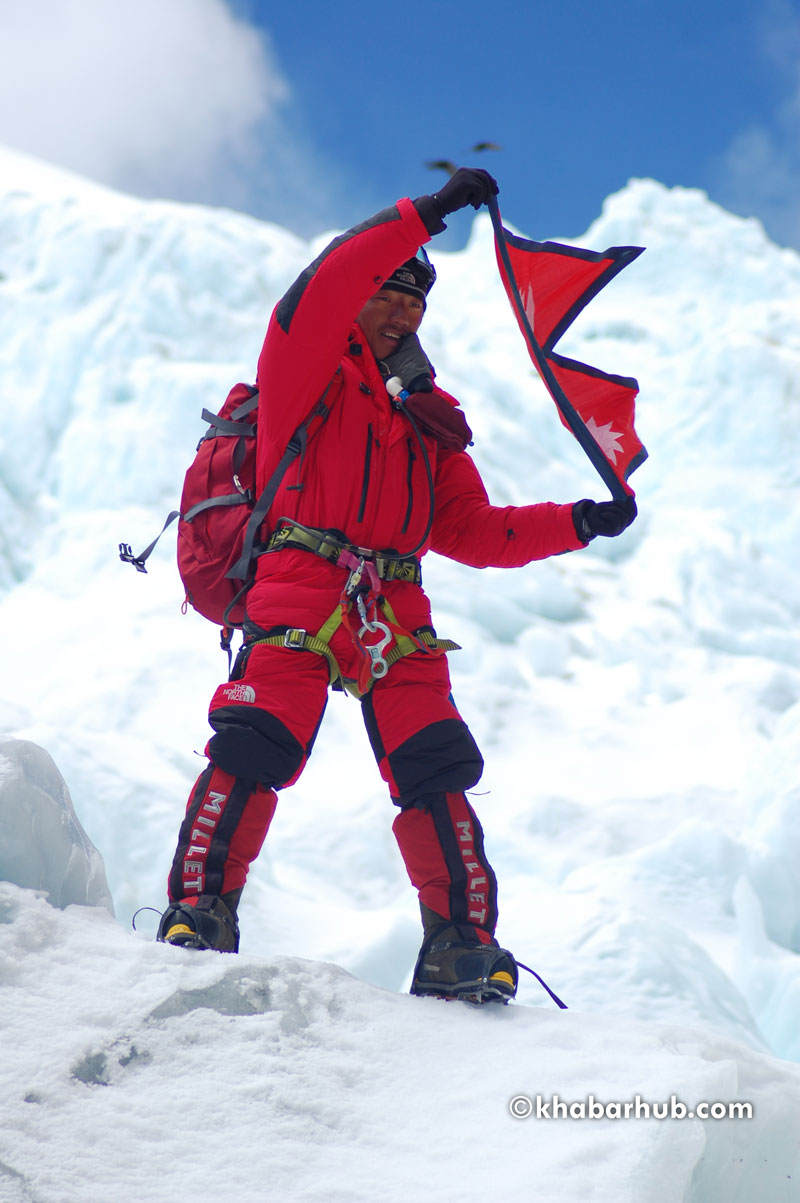
Photo: Thaneswar Guragai
In 2008 and in 2017, this enthusiastic Sherpa ascended the Everest twice in three days. He descended to Camp IV and climbed the peak again.
He reminisces those days when several porters came to the village from the lowlands and failing to cross the Tashi Lepsa Pass (5,750 m) to reach Lukla – a five-day trek — due to high altitude. “I then started working as a porter at a tender age,” he recalls. Barely three years working as a porter he made up his mind to give a try to climb the world’s highest peak. “I was able to gather the confidence, and finally I made it. I climbed the Everest from the Tibetan side with my eldest brother Pemba Dorje Sherpa in 2007,’ he told Khabarhub.
Before this, he made a failed attempt to ascend the Mt. Pumori (7,161 m) at the age of 16 years. “I could not reach the top due to an avalanche,” he recalls.
Sherpa community, he says, respect the mountains as God since they grow up in the lap of the mountains.
“We revere mountains as God like the way we love and respect our mothers,” he said.
Since then, there has been no looking back. “This boosted my morale,” says Phurba.
In 2008 and in 2017, this enthusiastic Sherpa ascended the Everest twice in three days. He descended to Camp IV and climbed the peak again.
He has also conquered Mt. Manaslu thrice. In 2011, he climbed Mt. Ama Dablam within ten days and stayed at the summit for a staggering 10 hours.
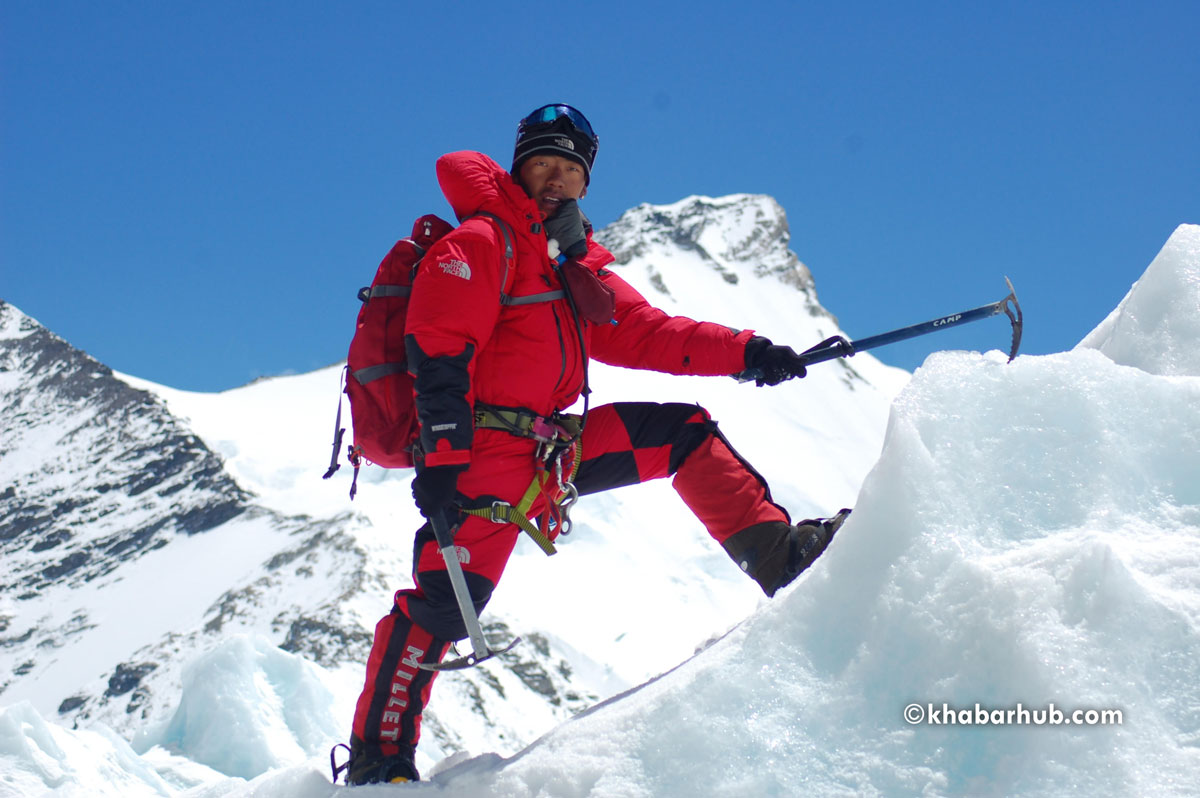
Photo: Thaneswar Guragai
Ask him what did he earn so far, and pat comes the reply: “The positive impression as well as the recommendation of being a hospitable guide and a supportive porter is what I have earned in all these years.”
Sherpa community, he says, respect the mountains as God since they grow up in the lap of the mountains.
“We revere mountains as God like the way we love and respect our mothers,” he said.
Phurba Tenjing, however, is saddened at the way the government has ignored the plights of Sherpa who guide mountaineers to the peak safely. “We feel overlooked,” he laments.
An adage, which he is accustomed to hearing from mountaineers, makes his chest broader. Consider this: “Everest can be conquered without oxygen, but not without the Sherpas.” What could be more heartening than this for Phurba and rest of the Sherpa porters and guides?
He is equally worried over the dwindling number of Sherpas in the mountaineering sector. “Youngsters have started losing interest in mountaineering as they are more options available. They prefer going abroad,” Phurba told Khabarhub.
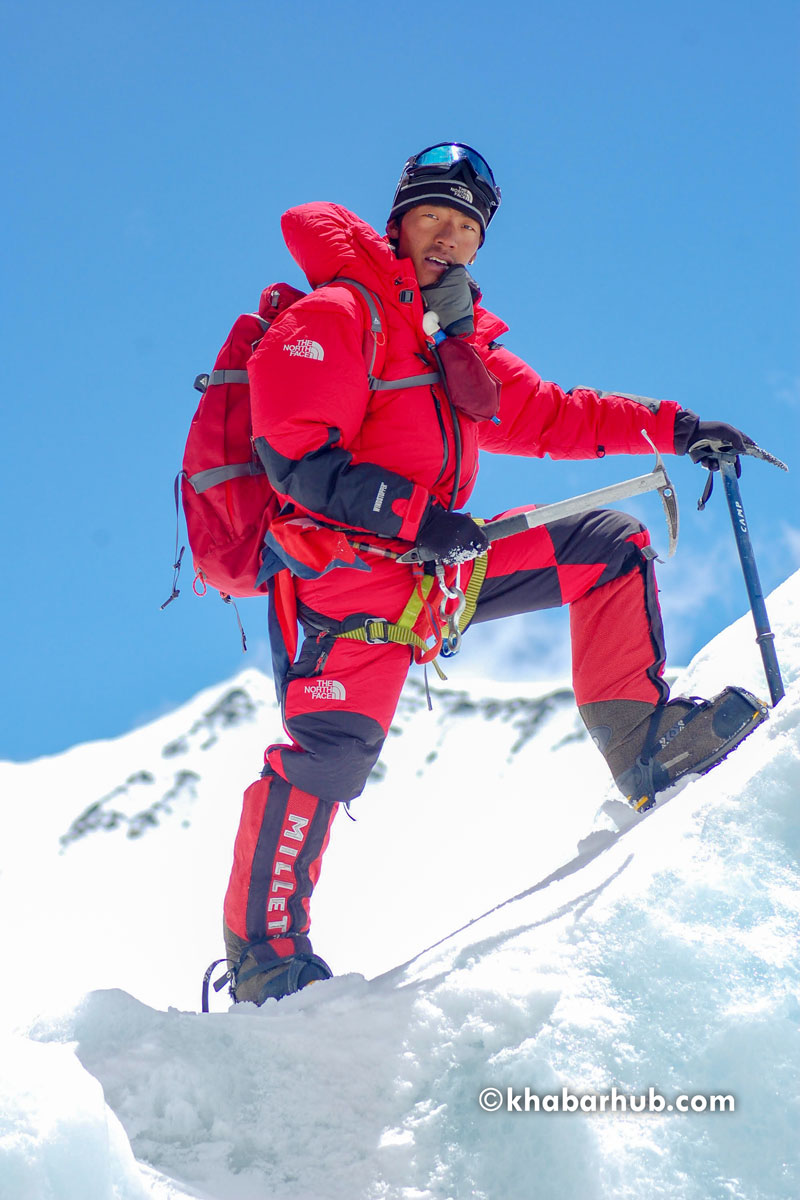
Photo: Thaneswar Guragai
In the course of the conversation, Phurba gives a sad expression while reminiscing a horrific moment when an avalanche hit the Everest in the 2015 devastating earthquake that left him with a fractured backbone. “I never thought that I would survive,” he said adding, “Even now, I get scared while ascending.”
An adage, which he is accustomed to hearing from mountaineers, makes his chest broader. Consider this: “Everest can be conquered without oxygen, but not without the Sherpas.” What could be more heartening than this for Phurba and rest of the Sherpa porters and guides?
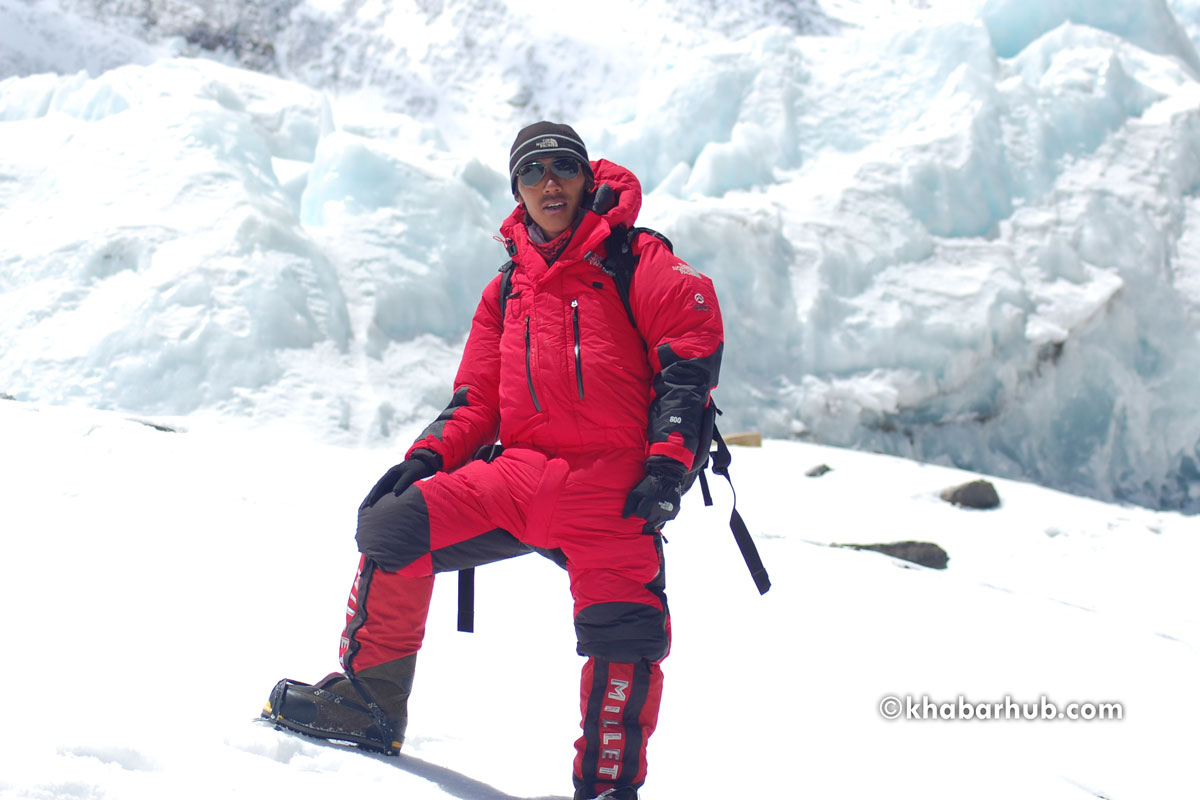
Photo: Thaneswar Guragai
By saying so, he also recalls the moment when he guided Rosha Basnet, a journalist, to the summit. “Rosha appreciated my support,” he says adding, “When God is always with us, why we need to fear?”
(With inputs from Thaneswar Guragai)
The past couple of days have witnessed heated media discussions on the two-day ‘Investment Summit Nepal-2019’ starting from today.
This is the second such summit preceded by the one held in 2017. The first summit had brought about 250 foreign investors securing letters of intent worth Rs. 13.74 billion.
The imminent summit is larger in scale in the sense that it is being participated by 600 investors from 40 countries. The summit titled ‘A Promising Investment Destination’, shall showcase a total of 77 projects in various sectors, worth $31.93 billion.
Criticisms facing the summit
Media is replete with a negative appreciation of the summit. Even before its commencement, the summit has invited a heap of negative comments. Many argue that it shall be a mere perfunctory summit for a number of reasons.
Others argue that the country is ill-prepared to invite Foreign Direct Investment (FDI) due to lack of friendly laws and regulations addressing prospective foreign investors. As such, it is too early to hold an ambitious investment summit.
The crux of all such arguments is that the country utterly lacks enabling investment environment. Security tops the list. Some point out that the violent activities by the ‘Biplav’-led Maoist outfit is ominous to an ideal investment climate in the country as it may gradually escalate to the level of violent Maoist insurgency (1990-2006).
Others argue that the country is ill-prepared to invite Foreign Direct Investment (FDI) due to lack of friendly laws and regulations addressing prospective foreign investors. As such, it is too early to hold an ambitious investment summit.
The inception
However, it should not be forgotten that efforts have been made to attract FDI in the country even before the 1980s, according to a Nepal Rastra Bank (NRB) report.
There were a few instances of foreign investment and technology transfer in the country before 1980. An investment promotion was meeting was organized in 1984.
Likewise, Nepal Investment Forum was held in 1992, according to NRB.
Investment Summit in the first week of March in 2017 had witnessed the commitment of USD 13.74 billion in ten sectors by 26 companies from eight countries.
Silver lining
As aforementioned, this summit is bigger in volume. Besides negative appraisals, the summit has some positive aspects as well. We are yet to see how the government shall resolve the issue of ‘Biplav’ outfit. Barring this, the investment climate seems to be improving in terms of policy and regulatory measures.
The government has made a number of improvement on laws and regulation in a bid to attract foreign investment. Some of them include that technology transfer is not a barrier for all types of industries in Nepal, laws have guaranteed repatriation in foreign currency, private sectors are allowed to develop and operate Special Economic Zones.
Similarly, companies can adopt “no work, no pay” system, and strikes and protests at companies are not allowed.
Regulations require a mandatory accident and health insurances for all employees and that companies are allowed to hire foreign nationals in managerial positions.
Nepal offers a golden opportunity for investors to exploit rich water resources by exporting electricity to India and Bangladesh under the existing regulation. One can dig gold in Nepal by investing in tourism, herb processing or the other number of projects being showcased at the summit.
Likewise, among other number of policy changes, investors are entitled to business and residential visas.
Nepal’s robust economic health can be another attraction for FDI. The country’s GDP growth rate has remained almost 5 percent in the past decade. It has witnessed a per capita growth rate of 8 percent in over a decade.
Similarly, the country has a foreign reserve to finance imports for up to 10 months. Besides, the country has 57 percent of the working age population.
Conclusion
Nepal is still a virgin land in terms of infrastructure development. The country requires a massive infrastructure development works to graduate to the level of a developed country.
Thus, it can be a fertile ground for countries statured with infrastructure development to not only try their technology and tools on the various infrastructure development of Nepal ranging from transportation to energy but also to reap benefits through investment.
Nepal offers a golden opportunity for investors to exploit rich water resources by exporting electricity to India and Bangladesh under the existing regulation. One can dig gold in Nepal by investing in tourism, herb processing or the other number of projects being showcased at the summit.
Yet, to truly realize the goal of this summit, the government needs to work in doing away with the hassles of red-tapism and corruption besides enacting more investment-friendly acts and rules.
What is climate change?
Climate change is a change in the usual weather. It could be a change in the rain or snow pattern or a place’s usual temperature for a season.
It is also a change in the earth’s climate or the earth’s usual temperature.
What needs to be understood is that while weather can change in just a few hours, the climate takes hundreds of years to change.
The earth’s climate has been constantly changing over geological time. Warming is occurring more rapidly than in the past. The natural fluctuation, or its variability, is being overtaken by rapid human-induced warming leading to serious implications for the earth’s climate.
How is climate different from weather?
Weather is the changes that we see, feel or witness outside each day. This could be a rainy day or could be sunny in a few hours. The weather can be cold or hot. In fact, weather varies from place to place.
Meanwhile, the climate is the usual weather of a certain place, and different in different seasons.
When we combine all the climates around the world together, that is the earth’s climate.
Changing the earth’s climate
Earth’s climate has been changing. There have been times when the earth’s climate has been cooler.
People studying earth see that its climate is getting warmer gradually. This means that the earth’s temperature has gone up by one degree Fahrenheit in the last 100 years. Even though this does not seem much, small changes in the earth’s temperature will have major big effects.
For example, warming of the earth’s climate has caused snow and ice to melt. It has also caused oceans to rise. Interestingly, the warming has changed the timing of the growth of plants.
Cause of the change
The main cause of climate change is the burning of fossil fuels like oil, coal that emits greenhouse gases into the atmosphere, mainly carbon dioxide. Human activities, such as deforestation and agriculture, too, contribute to the proliferation of greenhouse gases leading to climate change.
Several things can cause climate change. The earth’s distance from the sun can change because of which it sends out more or less energy to the earth. For example, the climate can change when a volcano erupts.
Scientists have to say that humans too change the climate. The energy that comes out from the vehicles, heaters, industries, coolers, fire, burning coals, oils, emissions, among others make an impact in the climate. These things send gases into the air which then cause the air to heat up leading to change the climate of a certain place. Consequently, this will change the earth’s climate.
Scientists view that the earth’s temperature will continue to increase for the next 100 years causing more snow and ice to melt, and oceans would rise. Several places would get hotter while some might have colder winters or some might get more rain, and some will witness droughts.
Greenhouse effect
The greenhouse effect is the way the earth’s atmosphere traps energy from the sun. The solar energy radiating back to space from the earth’s surface is absorbed by the atmospheric greenhouse gases and is re-emitted in all directions.
This energy radiating back down to the planet heats the lower atmosphere and the earth’s surface.
People are adding to the natural greenhouse effect with gases emitted from industries and agriculture, which leads to trapping more energy thus increasing the temperature. This is generally referred to as climate change or global warming.
The carbon dioxide takes hundreds of years for it to return to pre-industrial levels. Moreover, there is only so much carbon dioxide that can be soaked up by natural reservoirs, for instance, the oceans.
The emissions of carbon dioxide mainly come from the burning of fossil fuels and cutting down carbon-absorbing trees. Greenhouse gases like methane and nitrous oxide are also released through human activities.
Effects of climate change?
Rising ocean levels contribute to greater storm damage. Likewise, warming ocean temperatures lead to frequent storms, rainfall, flooding or other natural disasters. This can also increase the severity of wildfires, threatens habitats, human and animals life, among other serious consequences.
What we can do?
Humans can do or contribute to stopping climate change. Using less energy, water, turning off lights or TVs, refrigerators, fans when one leaves the room. Planting trees can be the best way.
Manaslu Base Camp, 4800m, trek has always been a fascinating route for trekkers and climbers. Also dubbed as an untouched paradise, it has been one of the most popular trekking destinations in Nepal.
Officially opened in 1992, the base camp route is considered as an adventure trek for travelers.
In fact, Manaslu trek offers an absolute view of the mountain peaks, rich cultural heritage, breathtaking panorama as well as rural civilization. To add more, it has an incomparable beauty blended with the natural assortment.
The majestic Mt. Manaslu, 8163m, which is one of the eight tallest mountains in the world, stands tall with its name “The Spirit-Mountain” in the local language.
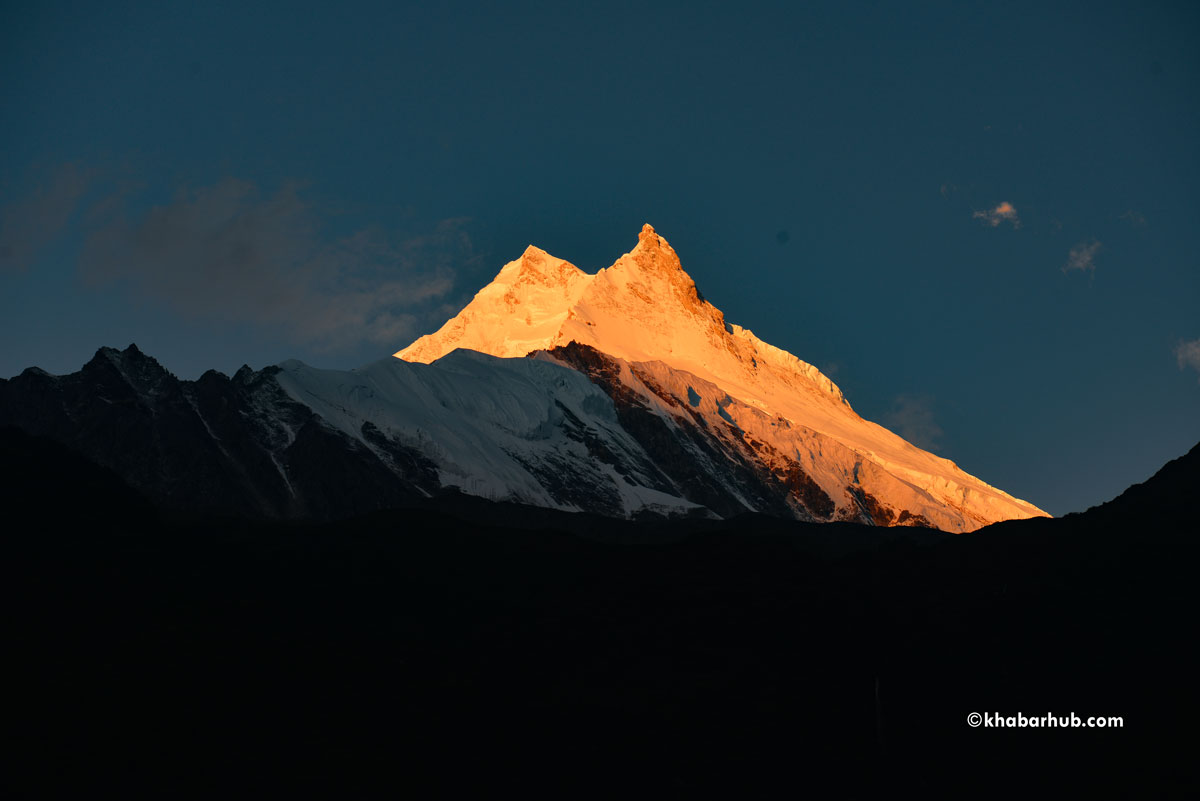
The sunrise view of Mt. Manaslu Main 8163m (L) and East pinnacle 7992m (L), seen from the renowned village Samagoan (3520m) of Gorkha.
Trek to the Manaslu Base Camp can be a blend of an unforgettable experience and wonderful adventure.
Trek to the Manaslu Base Camp begins from Sotikhola Bazar to Budhi Gandaki passing through steep yet picturesque valleys.
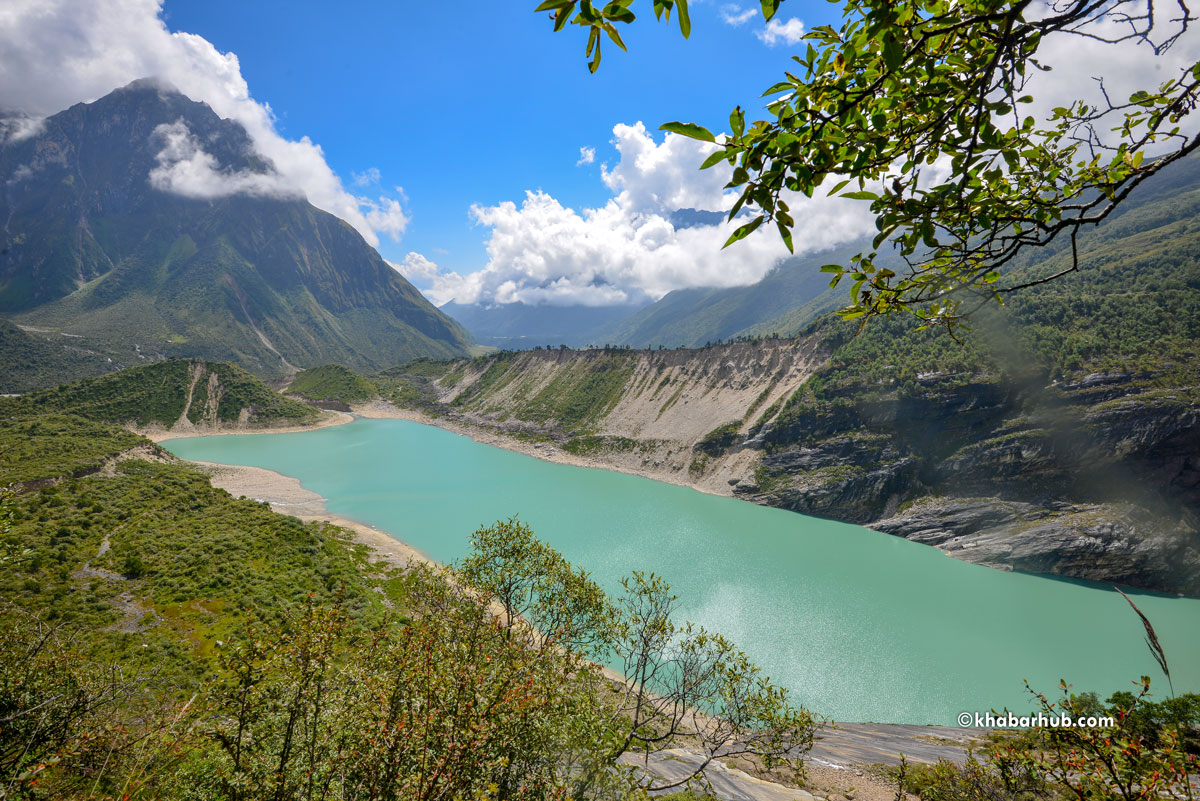
Magnificent view of Birendra Tal seen on the way to the Manalsu Base Camp.
The Manaslu base camp trek begins from Kathmandu to Arughat in Gorkha district. The 18-day trek will lead a traveler through the banks of the Budi Gandaki River passing through scenic valleys, green hills, ridges, jungles, prayer flags, Buddhist monasteries, typical villages, and what not!
The best time of Manaslu trekking begins from September, October and November or March, April and May. Trekkers are usually not recommended to go for trekking from June to August, which is a monsoon season.
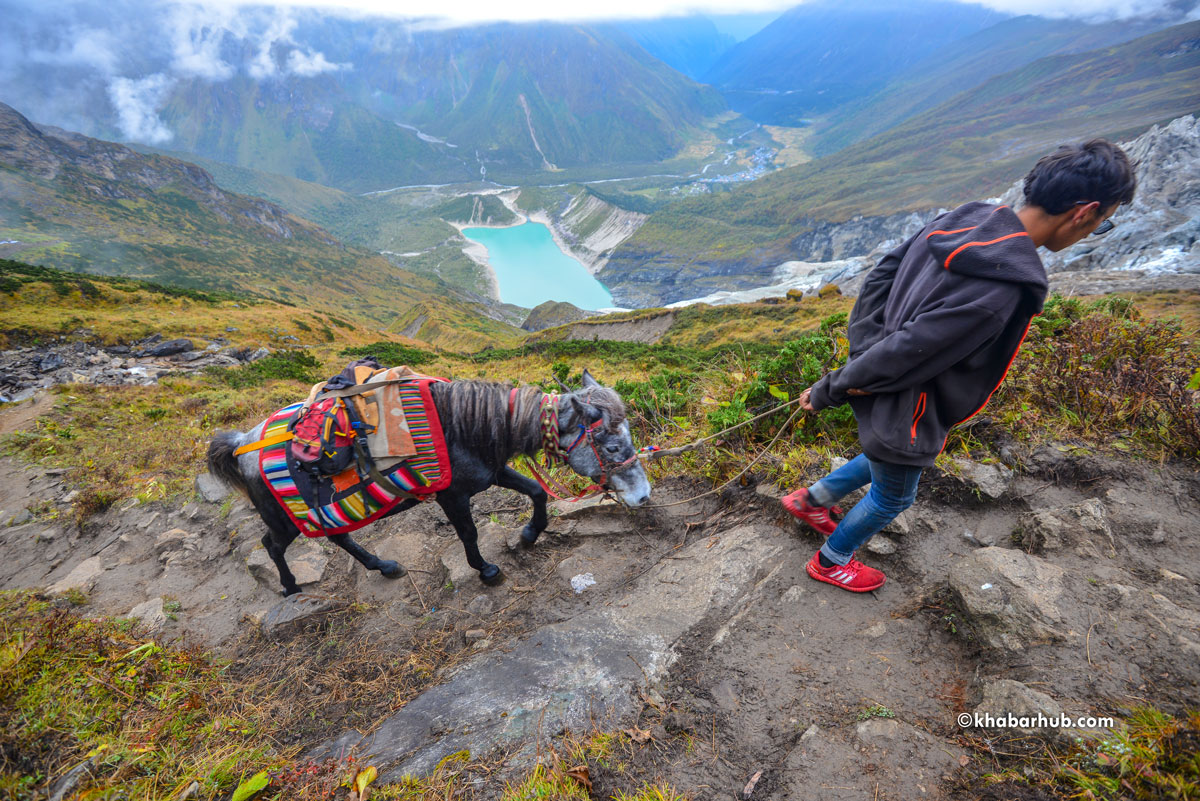
A man with a mule heading toward Manaslu basecamp (4800m). Donkey and mule are the major transportation means in the Manaslu Region.
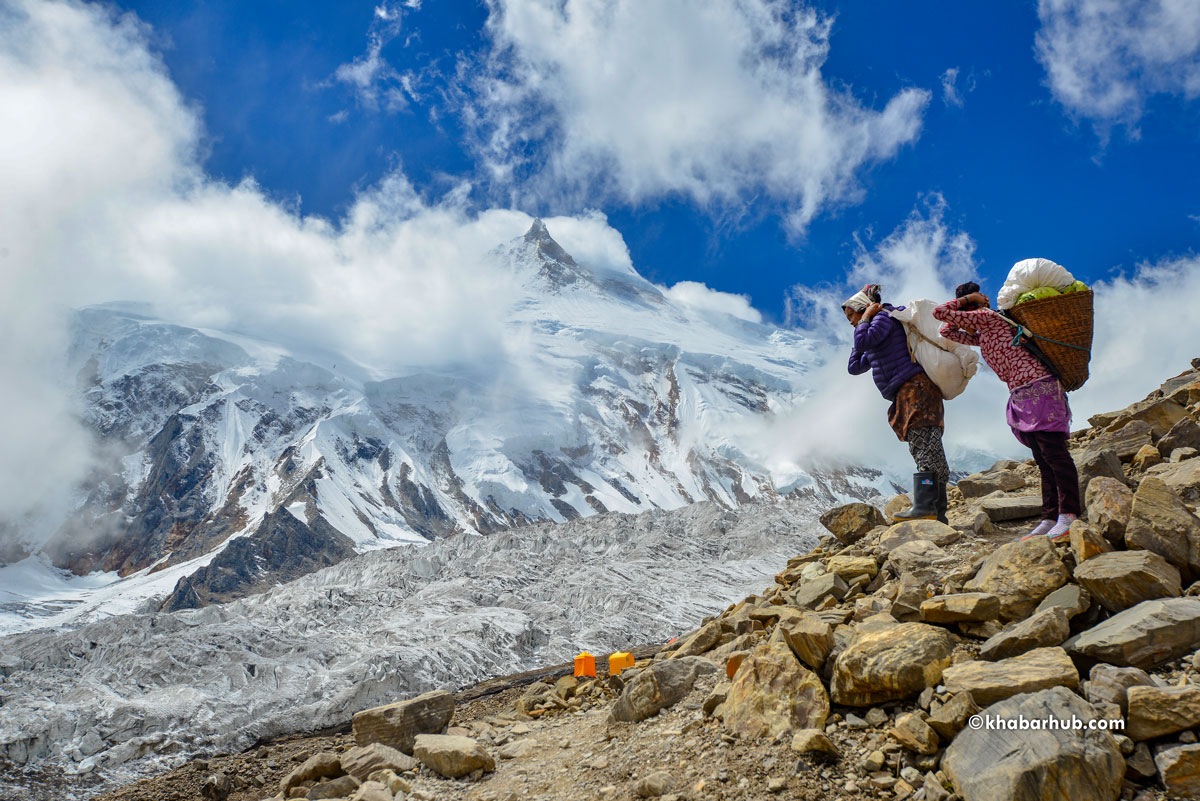
Two local women carrying loads to the Manaslu Base Camp.
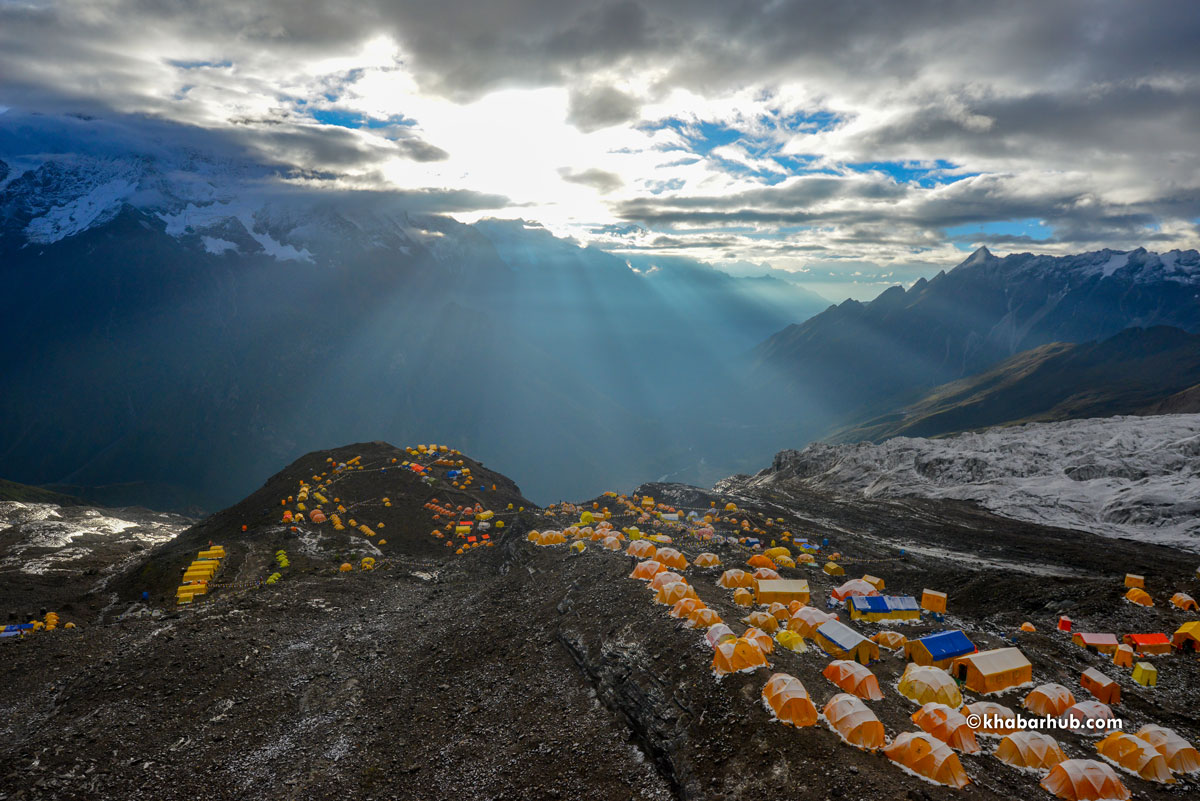
Tents at the Manaslu Base Camp (background is the Panpoche Peak 6620m). Climbers stay at the basecamp using tents for more than 30 days during the entire expedition. Each year more than 500 climbers climb the peak.
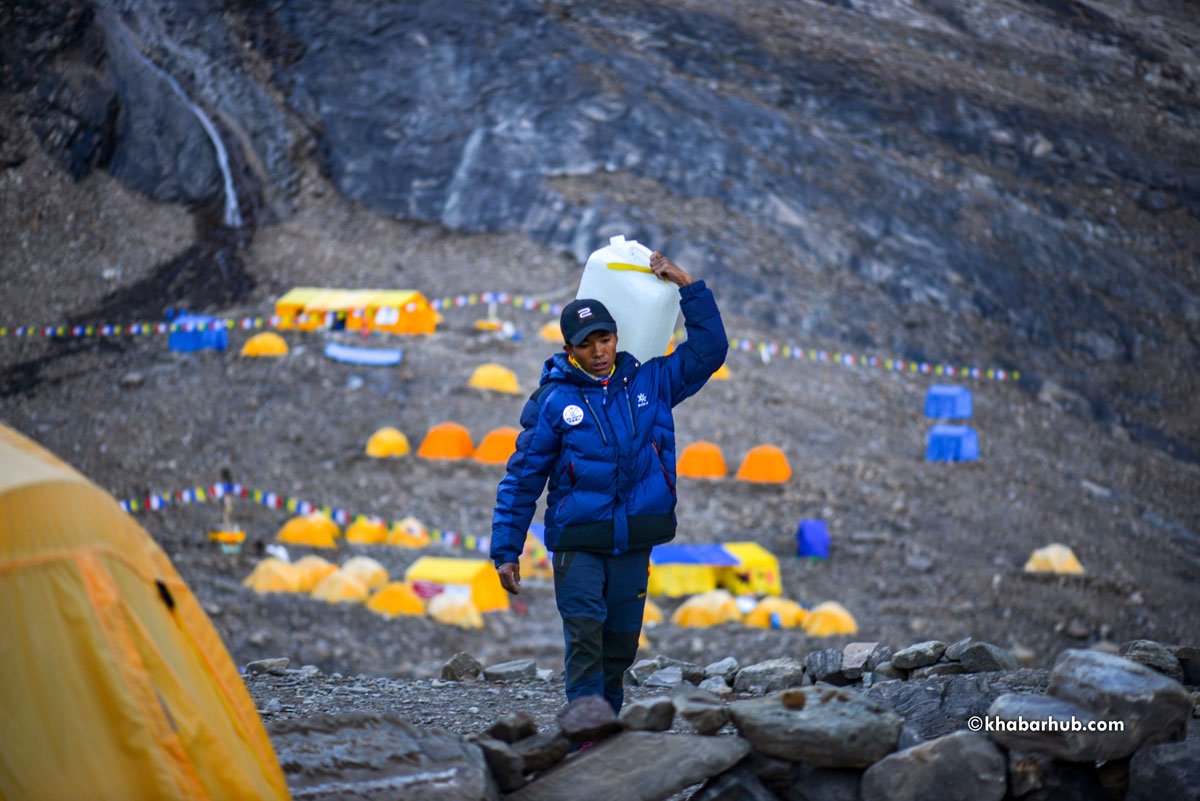
Man carry water from the source of melting ice at the basecamp.
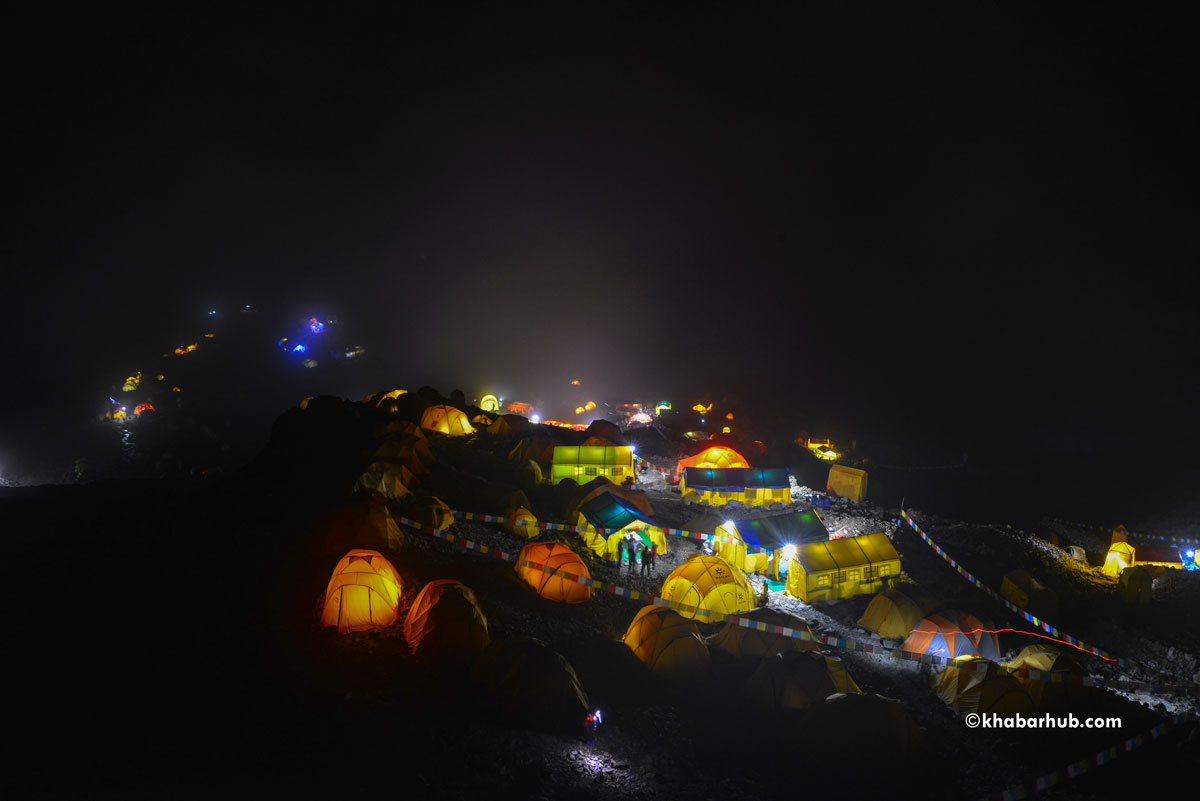
Lit up tents seen at the basecamp of Manaslu (4800m)
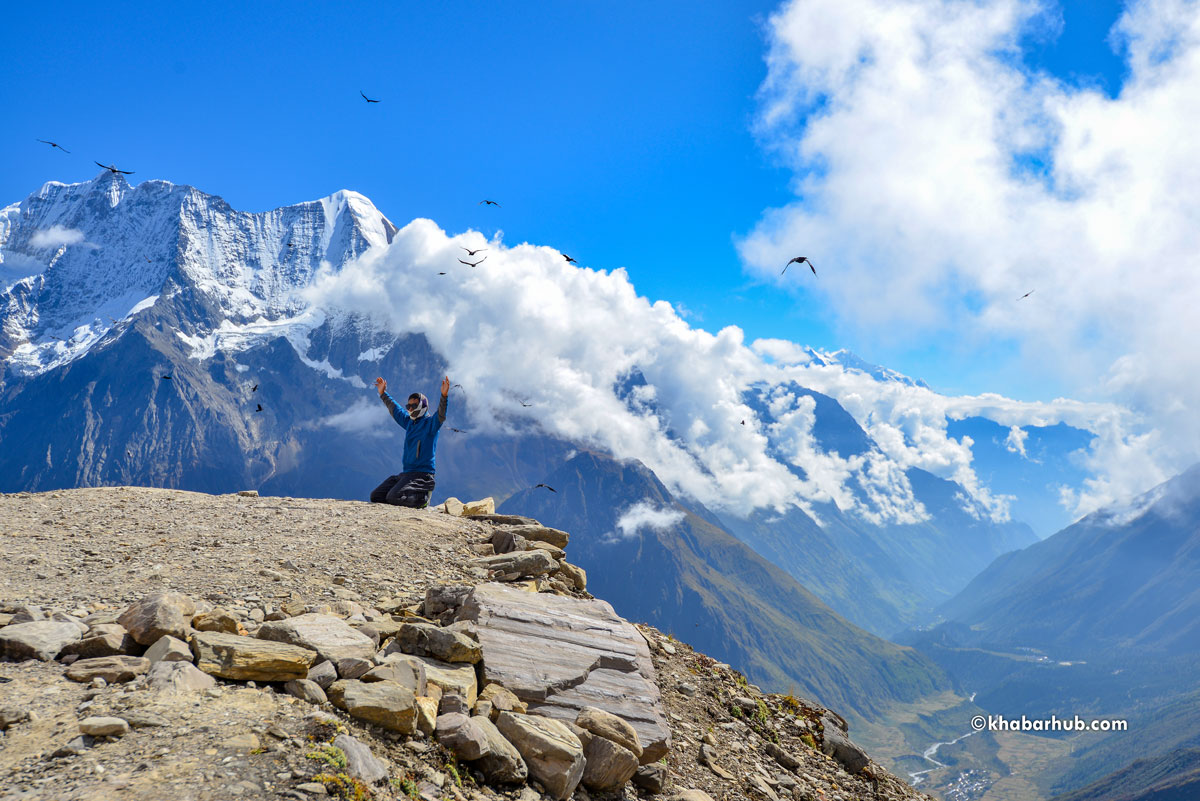
Man Marshaling helicopter at the basecamp. Some of the climbers chose to return to Kathmandu by helicopter after the climb. Helicopters are also used for rescue operations.
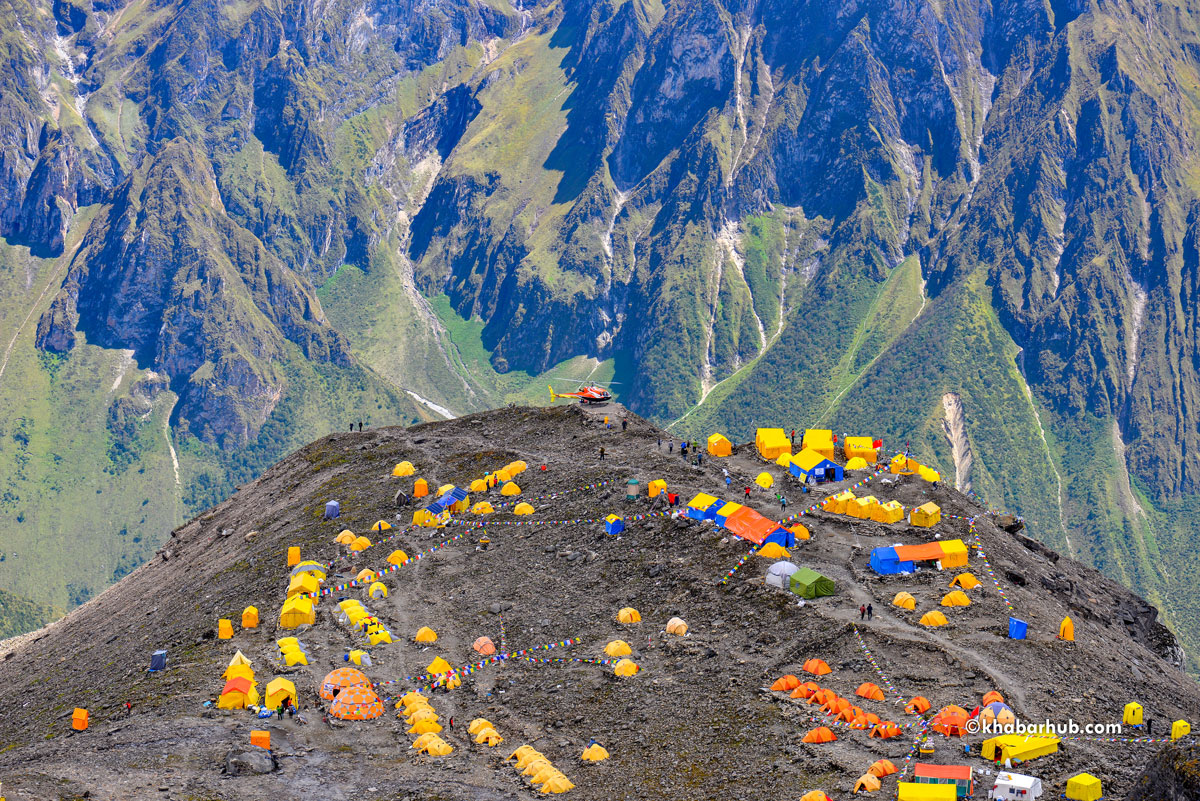
A chopper is seen at the Manaslu Base Camp.
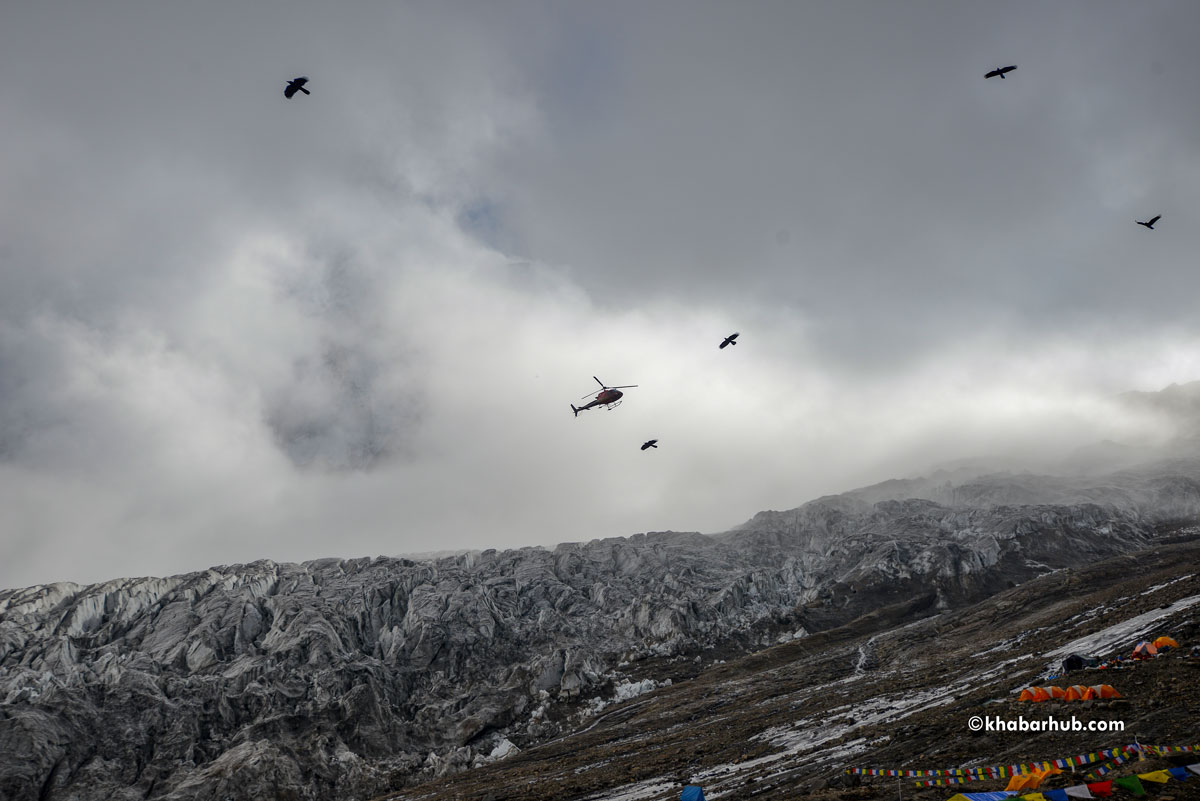
Helicopter and crows at the basecamp.
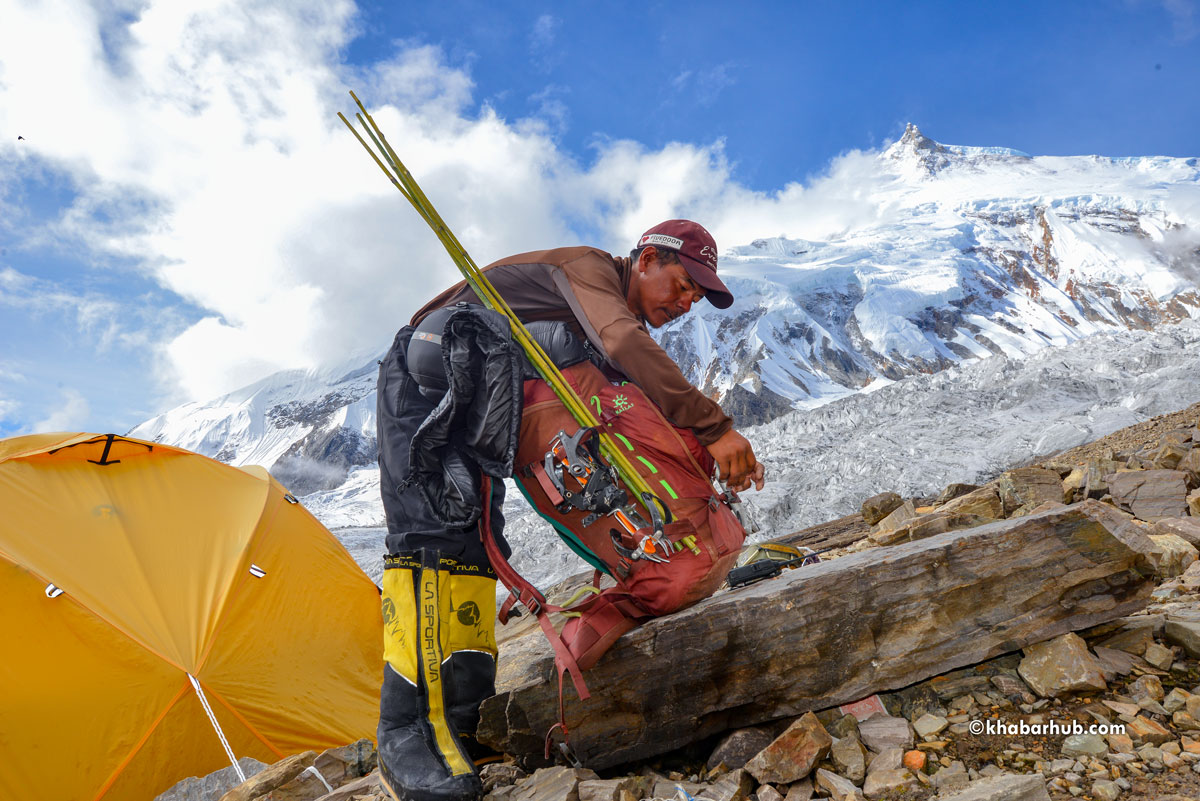
Sherpas preparing to go to the higher camp.
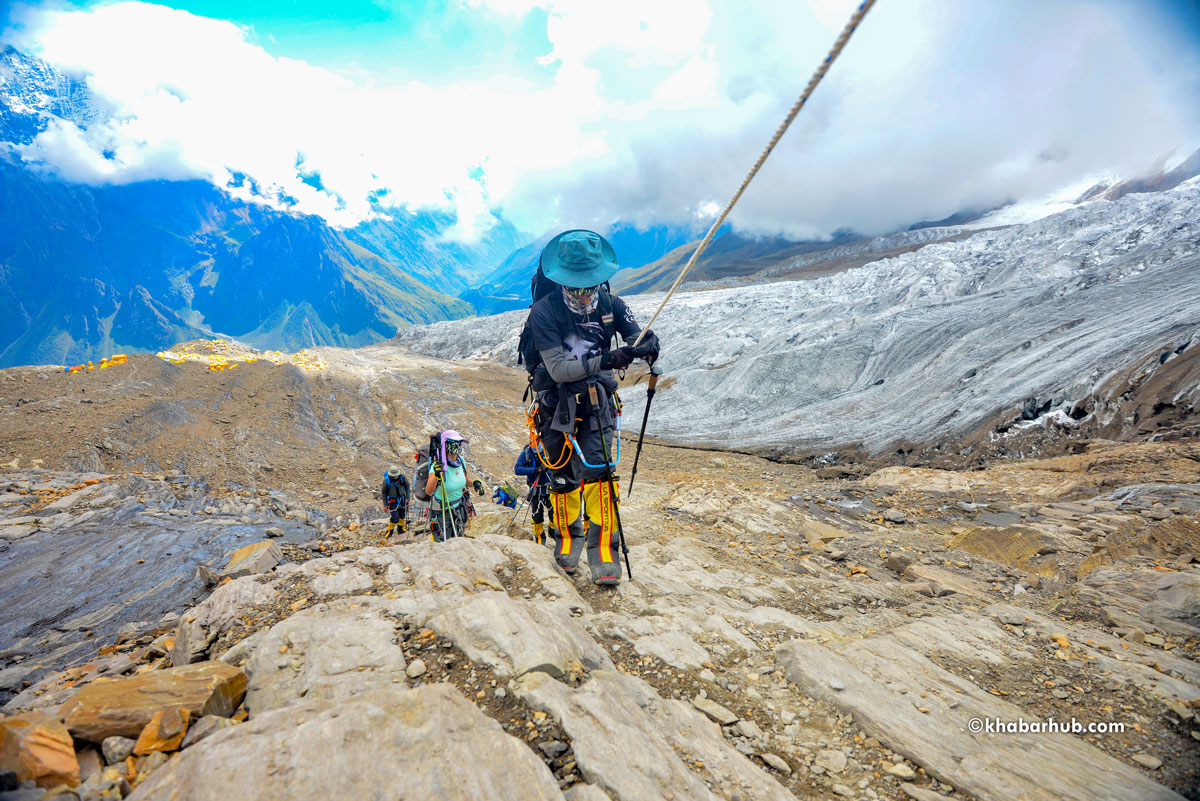
Climbers hiking towards Camp I from the base camp.
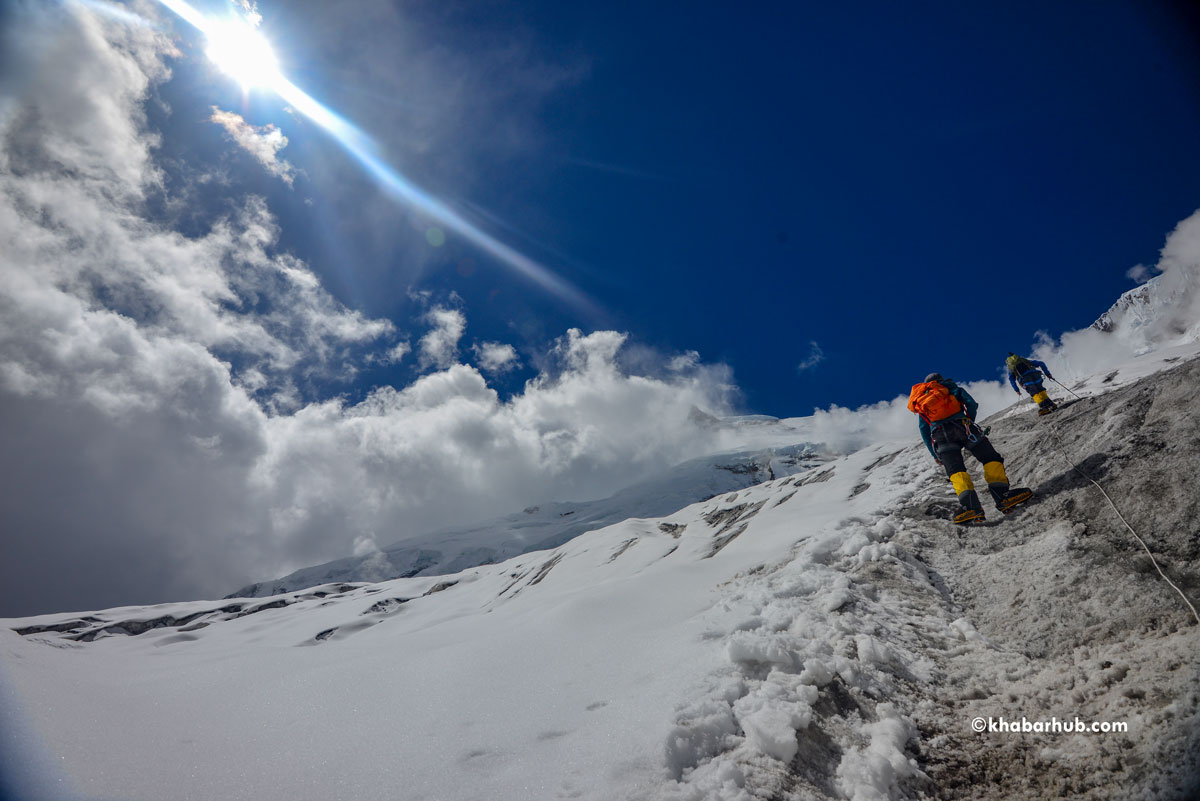
Climbers on the way to Camp 1.
KATHMANDU: Smuggling of invaluable medicinal herbs continues unabated in Nepal.
Authorities have claimed that high demand for the rare medicinal herbs in the markets of India, China, and other countries has tempted smugglers towards this lucrative business.
Around 7 hundred species of medicinal herbs are available in Nepal, according to a study conducted by the Department of Forests.
These rare species of herbs are going to be extinct if not protected by the government. The unbridled smuggling has posed a serious threat to the herbs.
Ayurvedic pharmaceutical industries, including the government-owned Singha Durbar Vaidyakhana, have complained that they are facing a shortage of medicinal herbs in recent times.
Herbs worth Rs millions smuggled
The absence of effective monitoring has encouraged smugglers to smuggle these herbs.
On February 8, police arrested a person Sher Singh Dhami, 48, with 715 kilograms of Setak Chini, locally known as Khiraula, concealed in a house at Chainpur of Bajhang district. Dhami, who originally hails from Apihimal Rural Municipality, Dharchula, landed in police net while he was preparing to smuggle the herbs to India.
On October 30, a squad of Armed Police Force (APF), Kalabanjar seized 75 kilograms of spikenard (Jatamasi) from Duduwa Rural Municipality of Banke.
Similarly, on September 22, police rounded up Mane Rokaya with 1,012 kilograms of Setak Chini in Budhinanda Municipality of Bajura.
Rokaya had collected Setak Chini from a nearby jungle which is priced at Rs 1,600,000 per kilogram in the local market. He was held while he was preparing to smuggle it to India in cahoots.
Influential mafias, according to police, have a hand in smuggling. They, residing in India, smuggle Nepal’s herbs to various countries via India.
These incidents are only the tip of the iceberg. The statistics maintained by the Nepal Police has shown that herbs worth millions of rupees are seized annually.
Police seized herbs worth Rs 16.6 million from Karnali Province in the Fiscal Year 2017/18 alone. Likewise, various types of herbs were seized from Kalikot, Mugu, Rolpa, and Rukum while they were being smuggled to India.
SSP Uttam Raj Subedi, the spokesperson of Nepal Police, admits the smuggling of herbs to India through porous borders.
“Priceless herbs available in Nepal are mostly smuggled to India. Only small portions of the herbs are illegally sold in the third country,” said SSP Subedi.
Influential mafias, according to police, have a hand in smuggling. They, residing in India, smuggle Nepal’s herbs to various countries via India.
Herbs are seized when setting fails
Herbs are collected from Nepal’s hilly districts, including Kalikot, Mugu, Humla, Jumla, Dolpa, Jajarkot, Darchula, and Bhajhang. Locals collect herbs in cahoots with the forest officials, local representatives and police despite government’s ban on the collection of such herbs.
“Herbs are smuggled in cahoots with locals, local representatives and police,” an official at the Ministry of Forests and Environment told Khabarhub on the condition of anonymity.
The herbs are seized when a disgruntled police official informs the higher authority about it after he is deprived of his pie.
According to herbs trader, the herbs are seized when setting among the local representatives, forest officials and police fails.
Nepali pharmaceutical deprived of herbs
With the Nepal government’s ban on the collection of some certain herbs, Nepal pharmaceutical companies are facing the shortage of herbs, entrepreneurs said.
Government-owned Sindha Durbar Vaidyakhana Development Committee had called for a quotation seeking 91 items of herbs in the fiscal year 2016/17. However, only 40 items of herbs were made available.
A quotation seeking 300 kilograms of Hadchur had been announced in the fiscal year 2017/18.
Vaidyakhana has not been able to meet the demands of Ayurvedic medicines due to the shortage of herbs, said Hari Prasad Yadav, acting chief of Vaidyakhana Development Committee.
No conservation despite the ban
The government has not taken any initiation to protect invaluable herbs despite a ban imposed on their collection.
These rare species of herbs are going to be extinct if not protected by the government. The unbridled smuggling has posed a serious threat to the herbs.
Besides, fire, deforestation are the other causes leading to the disappearance of such priceless herbs.
“The government has to either bring concrete plans to protect these herbs or lift the ban on their collection,” said a trader.
KATHMANDU: Drug trafficking, its consumption, and production, which have been the most serious issue across the world, have not spared Nepal, too.
It has been the most challenging task to crack down on the internationally organized network of drug traffickers across the world despite efforts made by law enforcing agencies.
Police have been keeping a close tab on drug-trafficking and have been arresting drug traffickers. However, the number of incidents has gone up in an unprecedented manner.
On December 16, Nepal Police arrested a Canadian national Denis Lapage with 2.985 kilograms of hashish at the Tribhuvan International Airport (TIA).
Drug trafficking has been a major income source for purchasing weapons which are used in the war-torn countries such as Afghanistan, Pakistan, Iraq, Yemen, African countries Libya, Sudan, Somalia, Mali, and Congo.
According to DIG Dinesh Amatya, spokesperson of Narcotic Control Bureau (NCB), the 61-year-old Denis was arrested during a security check possessing the drug while he was about to board a flight to Thailand.
This was only the tip of the iceberg.
According to the records maintained by the Nepal Police Headquarters, a total of 741 people, mostly Indian nationals, were arrested in the period of five years –2013 to 2018. Other include nationals from 33 countries such as Pakistan, China, Malaysia, Bolivia, Poland, Turkey, Russia, Canada, and Brazil.
Drug trafficking has been a major income source for purchasing weapons which are used in the war-torn countries such as Afghanistan, Pakistan, Iraq, Yemen, African countries Libya, Sudan, Somalia, Mali, and Congo.
Details of foreigners held
According to the information provided by the Nepal Police Headquarters, and NCB, as many as 152 foreigners have been held in 2014 for trafficking drugs via the route of Nepal. Similarly, 124 were arrested in 2015, 139 in 2016, and 159 in 2017. Similarly, in 2018, as many as 167 foreigners were arrested, police informed. Some of those arrested are women.
Nepal turning into a drug trafficking transit point
Analysts have said that drug traffickers chose Nepal as a transit point for trafficking drugs taking advantage of its weak security system. A large amount of drug is trafficked to India and vice versa through the Nepal-India open border checkpoints. Brown sugar, heroin, and cocaine are brought to Nepal from India while marijuana, hashish, and opium are supplied to India from Nepal.
Similarly, cocaine is produced in South American countries such as Bolivia, Colombia, and Peru. Cocaine is supplied targeting affluent countries since it is very expensive.
Most of the drugs manufactured in South Asia come to Nepal via India before they are trafficked to Europe and America from Kathmandu.
Where and who manufactures drugs?
Narcotic drugs especially, opium and heroin are manufactured in Afghanistan, Pakistan, and Iran. Similarly, they are also produced on the border areas of Thailand, Burma, and Vietnam, including some parts of Nepal.
Heroin is the major income source for carrying out terrorist activities in the war-torn countries across the world, said former AIG Debendra Subedi.
Similarly, cocaine is produced in South American countries such as Bolivia, Colombia, and Peru. Cocaine is supplied targeting affluent countries since it is very expensive.
Drugs, which are used in Nepal include white heroin, raw brown sugar, marijuana, hashish among others.
Drug-trafficking has multi-faceted ramifications
Drug consumption, production, and trafficking have been the most serious problem in the world, of late.
According to former AIG Subedi, the drug is not only an addiction but has multi-faceted problems.
The income made through drug trafficking is used to promote the culture of corruption, terrorism, and crimes. It is also used to exert pressure on the government, power politics among others.
KATHMANDU: Dr. Saraswati Padhay, in her late seventies, is still active as a doctor and a professor at the Sinamangal-based Kathmandu Medical College (KMC) hospital. What is unique about her is the fact that she served the royal family rendering delivery services for late queen Aishwarya.
Dr. Padhay has a perfect granny look with a wrinkled face and grey hair ever lit with smiles. However, her enthusiasm at work beats young doctors. She is still a dedicated doctor.
“I can tell for sure that the medical service to rural people was much effective and easy during those days. Now, it’s beyond the reach of many people since they have to travel to the city. Meanwhile, the treatment cost is high now,” she says.
Upon completion of her school, she studied science at Tri Chandra College in Kathmandu. She left for India in 1959 to pursue studies on Bachelors of Medicine, Bachelors of Surgery (MBBS).
After earning the MBBS degree in three years, she returned to Nepal and started practicing. During her service, she traveled across the country working at various hospitals where she served the rural populace by attending regular health camps organized by the government in the villages.
“The rural populace had easy access to health in the past because the government organized regular health camps in villages,” she recalls.
Such health camps also provided surgery depending on the need of a patient. Meanwhile, the government took care of the medicine and the treatment, according to her.
“I can tell for sure that the medical service to rural people was much effective and easy during those days. Now, it’s beyond the reach of many people since they have to travel to the city. Meanwhile, the treatment cost is high now,” she says.
As a Gynecologist, she remembers her service that she rendered while providing delivery services to the second and the third child of late King Birendra and Queen Aishwarya.
“In fact, I could feel a sense of discrimination during the birth of a son and a daughter in the royal family. I remember how the palace enjoyed the moment when Queen Aishwarya gave birth to a son. However, if I do not forget, I did not witness any merriment during the birth of a daughter,” she told Khabarhub.
According to her, she remembers how the medical team was rewarded by the palace during the son’s birth. “We did not know what went wrong when a daughter was born!” she quips.