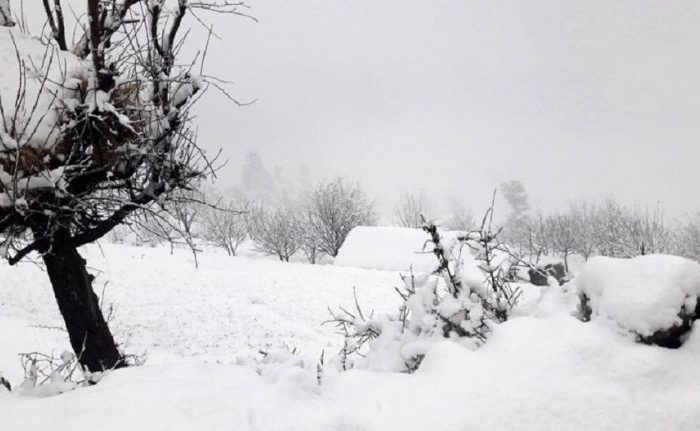





Mt Everest, world’s highest peak, brings hundreds of adventure aspirants in a season from around the world.
If anyone asks you why do you climb Mt Everest, then pat comes the famous answer of climber George Mallory: “Because it is there!”
Day one:
Kathmandu to Phakding via Lukla
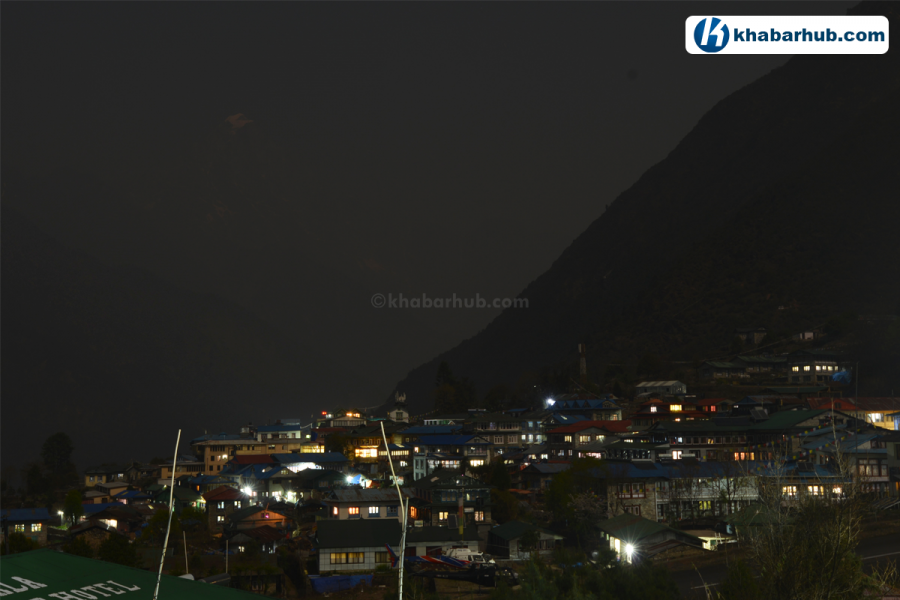
Photo: Thaneswar Guragai
Fly from Kathmandu to Lukla (2800 meters) and then trek for three hours to reach Phakding covering a distance of approximately 8km. Stay overnight at Phakding and stay at a lodge with a two-star facility.
Day two and day three
Phakding to Namche
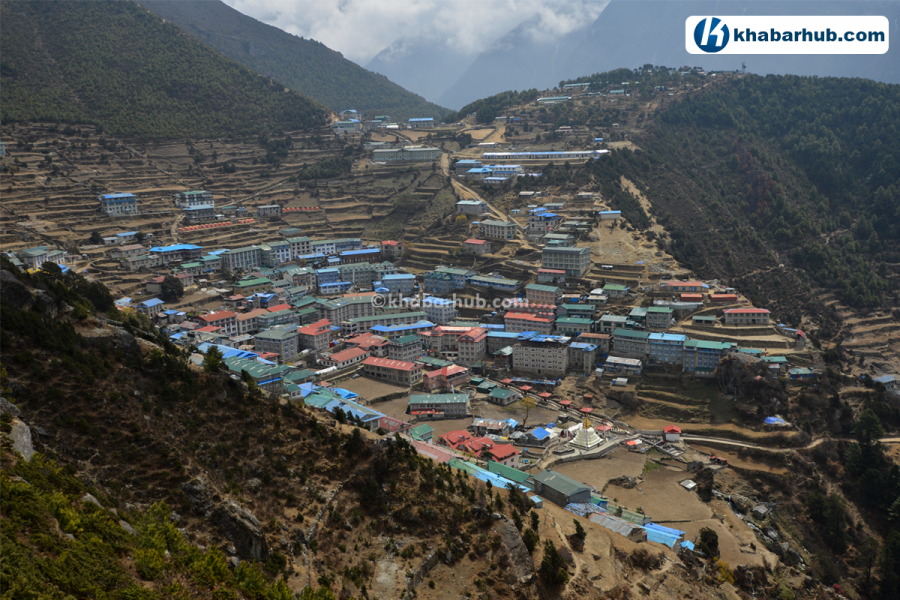
Photo: Thaneswar Guragai
After breakfast at Phakding, trek to Namche Bazaar, gateway to Everest, located at the height 3,440 meters. Namche Bazaar is also the entry of Sagarmatha National Park. Stop on the way for lunch and snacks enjoying the exotic Himalayan range. Reach Namche bazaar in around six hours covering a distance of around 11km. Two overnight-stay at Namche Bazaar. In the second day, tourists normally visit Everest View Hotel, listed as a hotel located in the highest altitude.
Enjoy the local culture and spend the day around Namche Bazaar. Overnight stay at Namche Bazaar for acclimatization.
Day four
Namche to Tengboche
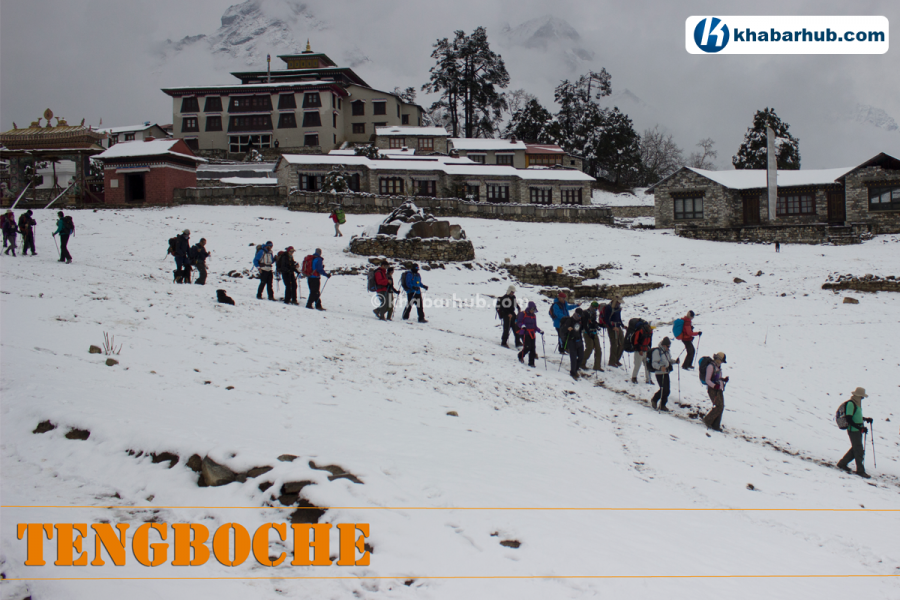
Photo: Thaneswar Guragai
After breakfast, trek from Namche to Tengboche covering a distance of around 11km within five hours. Overnight stay at Tengboche. Tengboche is located at the height of 3860 meters. Tengboche monastery is the main attraction. It offers a panoramic view of the Everest, Nuptse, Lhotse, Ama-Dablam and other Himalayan ranges. Overnight stay at Tengboche.
Day five
Tengboche to Dingboche
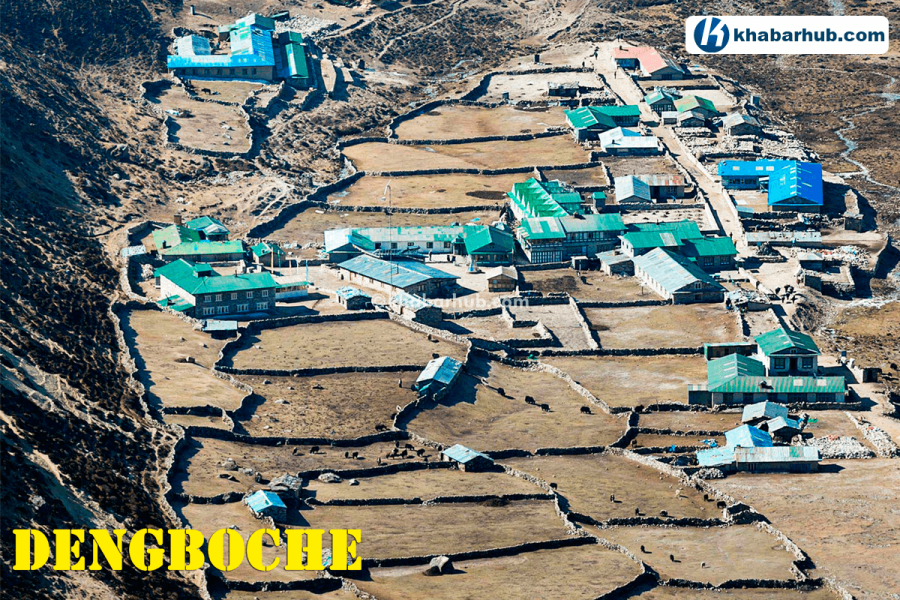
Photo: Thaneswar Guragai
After breakfast, trek to Dingboche from Tengboche covering a 5-hour-trek of around 12km. Located at the height of 4,250 meters, you will reach Dingboche, a Sherpa village, which is preferred for acclimatization. In the first successful Everest expedition in 1953 by Tenzing and Edmund Hillary, this place had served as the Everest Base Camp. Thanks to global warming, Dingboche does not possess as much snow now.
Day six and seven
From Dingboche to Lobuche
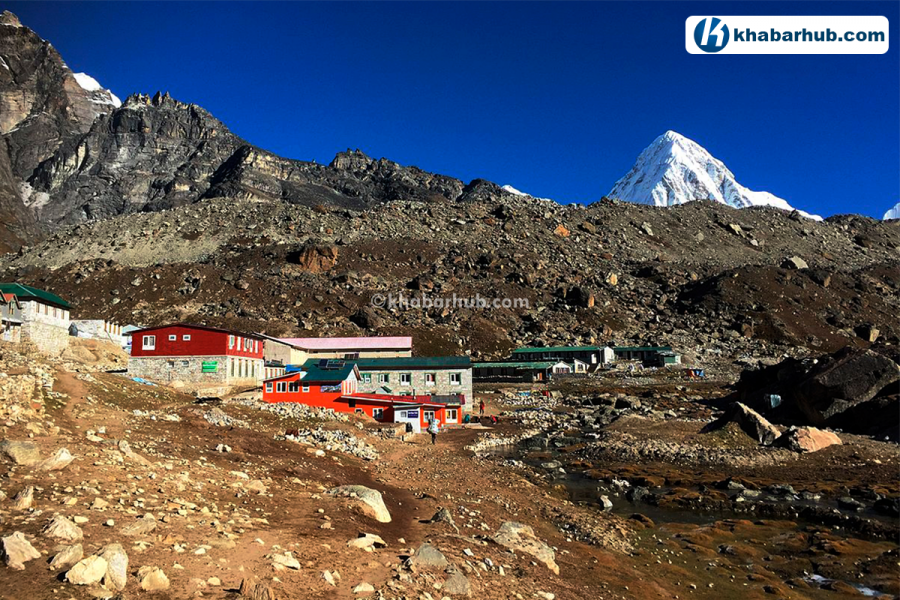
Photo: Thaneswar Guragai
After breakfast, trek from Dingboche to Lobuche covering a distance of some 12km in around five hours. Overnight stay at Lobuche, a Sherpa village located at the height of 4930 meters. It is located in the lap of Lobuche peak (6,119 meters). Most of people prefer to ascend Lobuche peak as part of acclimatization.
Day eight
Lobuche to the Everest Base Camp
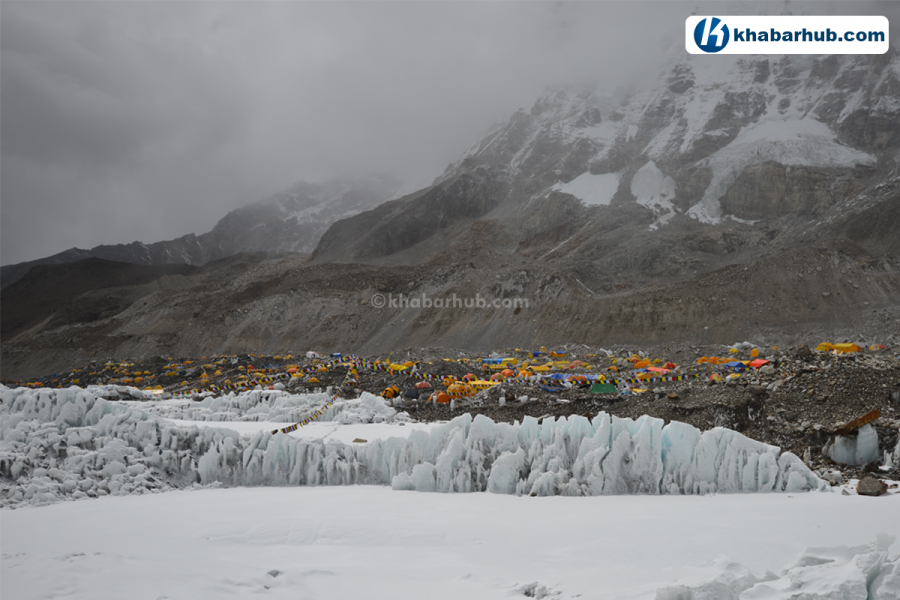
Photo: Thaneswar Guragai
After breakfast at Lobuche, head to the Everest Base Camp covering a distance of around 15km in eight hours. It is basically taken as a dream camp for trekkers, the starting point for climbers. Around 1,800 to 2,200 people are seen around the base camp during spring each year spreading tents waiting for more than 600 climbers to Everest, Lhotse, and Nuptse. The base camp resembles a bazaar.
People rest at the base camp for around five to six days and then begin their climbing training.
Camp One (6050 meters)
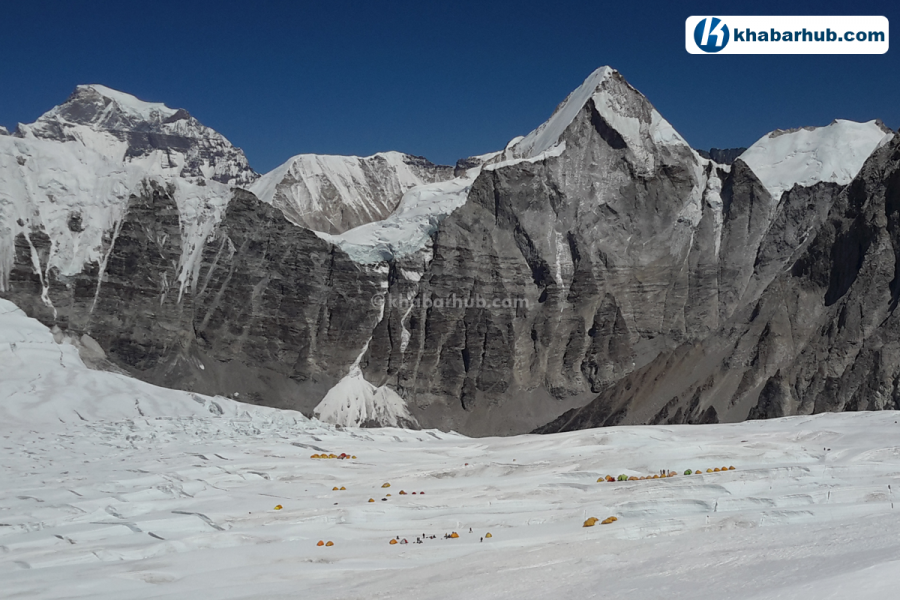
Photo: Thaneswar Guragai
From the Everest Base Camp starts the journey of the Everest ascent. Camp One is extremely challenging due to the notorious Khumbu icefall.
Camp two (6500 meters)
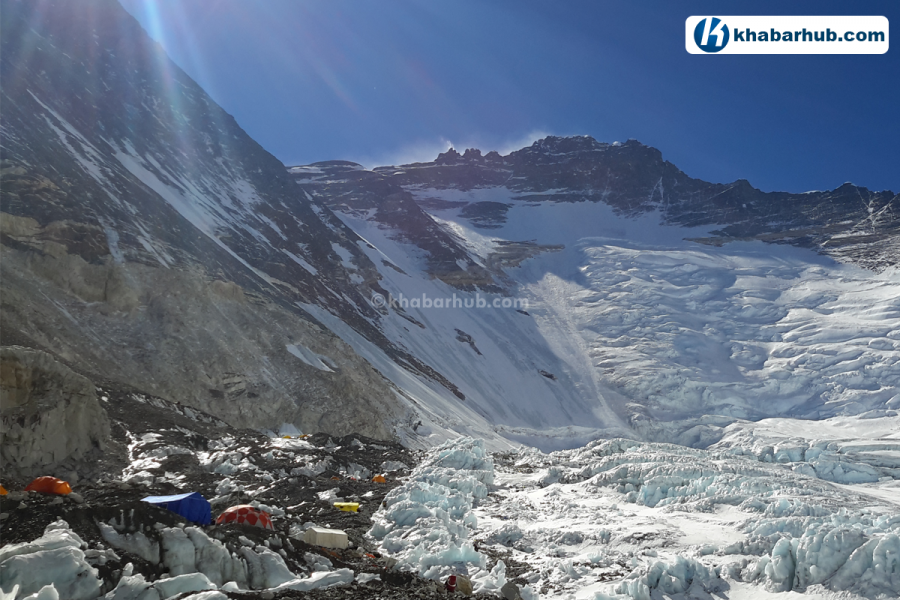
Photo: Thaneswar Guragai
Camp Two is rather easy with a slightly sloppy route. It is set against the southern wall of the Everest. Climbers stay more than two nights at Camp Two as part of the climbing rotation (for acclimatization).
Camp three (7200 meters)
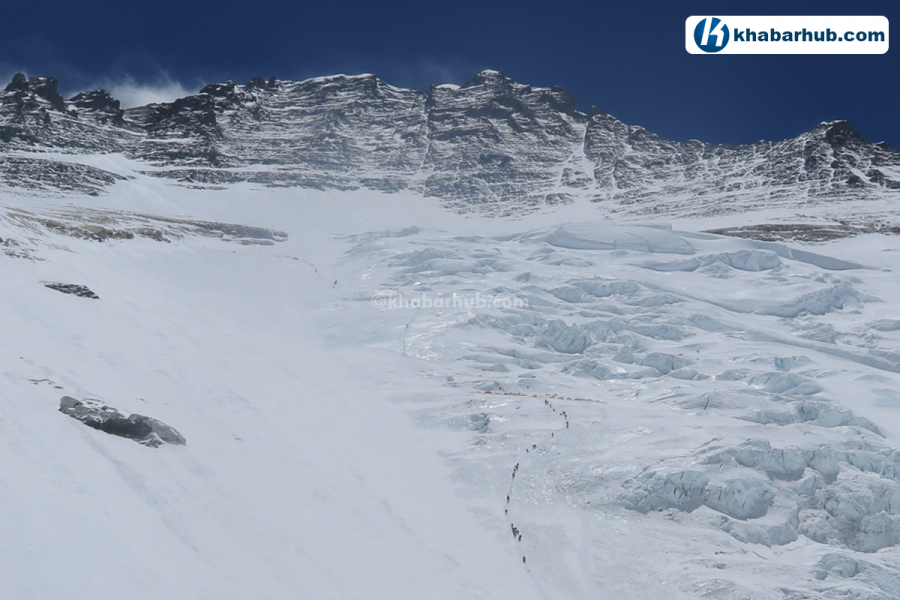
Photo: Thaneswar Guragai
Camp three serves as the resting place for climbers and is fixed on the sloppy area of Lhotse face. Reaching Camp Three is difficult because of the stiff climb. Climbers use crampons and ice axe to reach the camp.
Camp Four (South Col) (7900 meters)
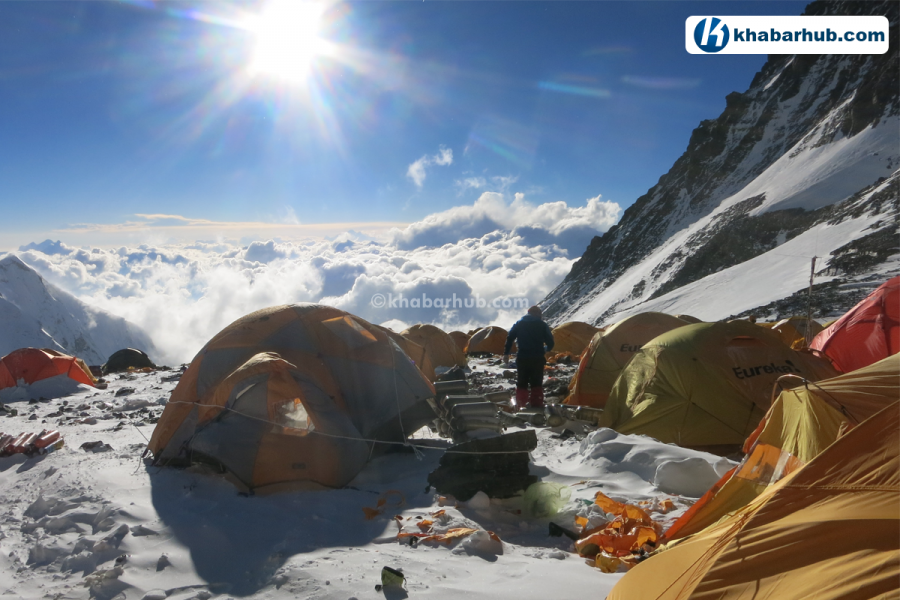
Photo: Thaneswar Guragai
Sherpas deposit oxygen, and other gears and materials at this camp. It serves as the base camp for the summit push. This means there are no other camps from Camp Four to the top of the Everest. The journey to and fro from this camp to the top requires 16 to 18 hours.
Hillary Step
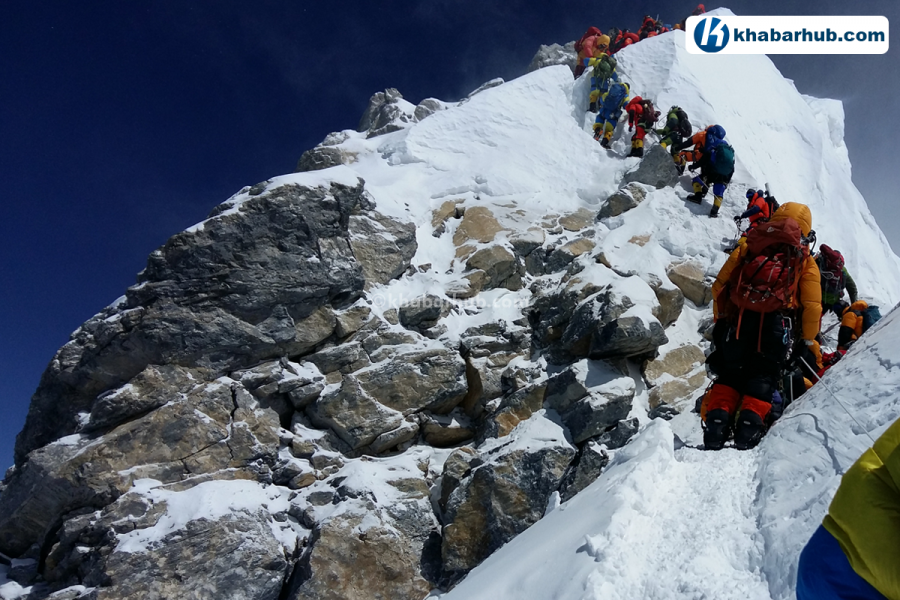
Photo: Thaneswar Guragai
This lies at the height of 8,790 near the summit. This step is named after Edmund Hillary. Until 2015, this step was very challenging because the climbing route lied in amidst huge boulders and passing through was difficult. Climbers often got stuck and even faced death. However, thanks to the massive 2015 earthquake, boulders have made the climb easy and smooth.
Everest Summit (Third Pole)
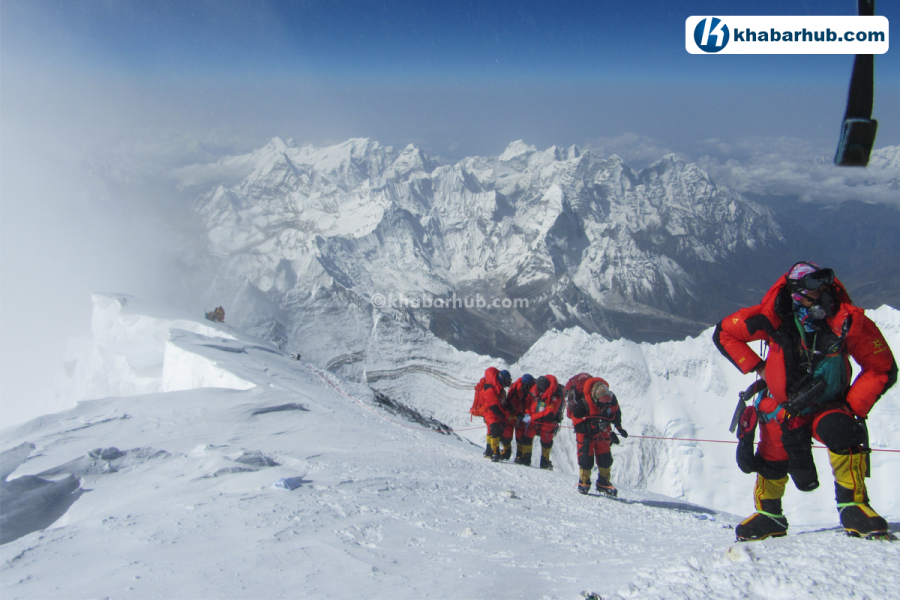
Photo: Thaneswar Guragai
The summit measuring 8,848 meters is the ultimate goal of the climbers where they spend five to ten minutes. It provides a close view of Mt. Cho-Oyu and Mt. Makalu. One can have a clear view of the landscape on the Nepal and Tibet sides. Around 8,000 climbers, including Sherpas, have made it to the summit so far.
KATHMANDU: A total of 42 Nepali women have scaled the Mt. Everest so far. Pasang Lhamu Sherpa reached the world’s highest summit on April 22, 1993, becoming the first Nepali woman to conquer the third pole, according to the Department of Tourism.
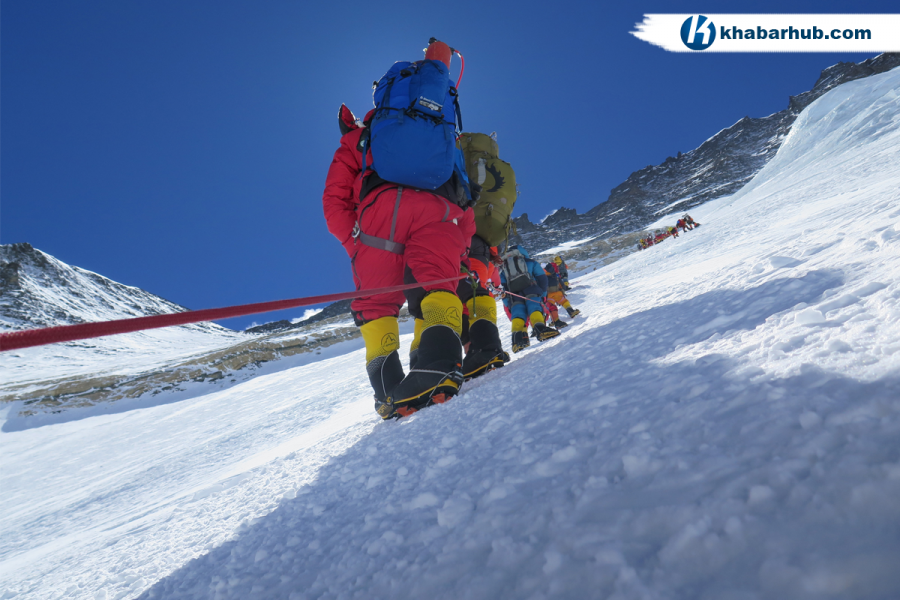
Lakpa Sherpa of Sankhuwasabha holds the record among the Nepali women scaling the Mt. Everest for nine times. Born at a remote village Tashigaun, Makalu-Barun in Sankhuwasabha, Lakpa started her mountaineering career as a helper of a trekking group 17 years ago. She reached the top in 2000, 2001, 2003, 2004, 2005, 2006, 2016, 2017 and 2018.
In 2008, a total of 10 Nepali women made it to the peak. Likewise, 1993, 2001, 2004, 2009 and 2013 witnessed a single woman each scaling the mountain, according to the record.
According to the record maintained by the Ministry of Culture, Tourism and Civil Aviation, as many as 18 women scaled the world’s highest peak in 2018, the highest record ever. Those include Rosha Basnet, Rojita Buddhacharya, Deurali Chamling, Phunjo Jhangmu Lama, Kalpana Maharjan, Chhoki Sherpa, Dabuti Sherpa, Dawa Diki Sherpa, Dikki Sherpa, Doma Sherpa, Lakpa Yangi Sherpa, Lakpa Sherpa, Nima Jangmu Sherpa, Pasang Lhamu Sherpa, Yangdi Sherpa, Purnima Shrestha, Kanchhi Maya Tamang, Lukme Tamang. Basnet and Shrestha are journalist and photojournalist respectively, according to the data available at the department .
In 2008, a total of 10 Nepali women made it to the peak. Likewise, 1993, 2001, 2004, 2009 and 2013 witnessed a single woman each scaling the mountain, according to the record.
Likewise, Maya Sherpa of Patle 5, Okhaldhunga conquered Mt Everest three times. Similarly, Sushmita Maskey, Ming Kipa, Ngawang Phuti, Pemba Doma Thaktopa Sherpa and Kanchi Maya have climbed the peak two times each.
Most of the women who conquered Mt. Everest belong to the Sherpa community. Out of 42 climbers, 21 of them belong to the Sherpa community whereas others represent the Tamang, Newar, Gurung, Limbu, Rai, Brahmin and Chhetri communities. Pasang Lhamu Sherpa is the only woman climber who died after climbing the Mt. Everest successfully.
| YEAR | NAME |
| 2018 | Rosha Basnet |
| 2018 | Rojita Buddhacharya |
| 2018 | Deuralee Chamling |
| 2018 | Phunjo Jhangmu Lama |
| 2018 | Kalpana Maharjan |
| 2018 | Chhoki Sherpa |
| 2018 | Dabuti Sherpa |
| 2018 | Dawa Diki Sherpa |
| 2018 | Dikki Sherpa |
| 2018 | Doma Sherpa |
| 2018 | Lakpa Yangi Sherpa |
| 2018 | Lakpa/Lhakpa Sherpa |
| 2018 | Nima Jangmu Sherpa |
| 2018 | Pasang Lhamu Sherpa |
| 2018 | Yangdi Sherpa |
| 2018 | Purnima Shrestha |
| 2018 | Kanchhi Maya Tamang |
| 2018 | Luckme Tamang |
| 2017 | Bhumira Gurung |
| 2017 | Nanu Maya Gurung |
| 2017 | Lakpa/Lhakpa Sherpa |
| 2017 | Kanchhi Maya Tamang |
| 2016 | Lakpa/Lhakpa Sherpa |
| 2016 | Maya Sherpa |
| 2013 | Nisha Adhikari |
| 2012 | Beena Magar |
| 2012 | Dawa Yangzum Sherpa |
| 2012 | Ngim Chhamji Sherpa |
| 2011 | Susmita Maskey |
| 2011 | Chhurim Dolma Sherpa |
| 2011 | Ngawang Bhutik (Nawang Futi) Sherpa |
| 2009 | Junita Sambahamphe |
| 2008 | Pujan Acharya |
| 2008 | Shaile Basnet |
| 2008 | Usha Bista |
| 2008 | Maya Gurung |
| 2008 | Susmita Maskey |
| 2008 | Ngawang Bhutik (Nawang Futi) Sherpa |
| 2008 | Nima Doma Sherpa |
| 2008 | Pema Diki Sherpa |
| 2008 | Chunu Shrestha |
| 2008 | Asha Kumari Singh |
| 2007 | Maya Sherpa |
| 2007 | Mingkipa Sherpa |
| 2007 | Pasang Lhamu Sherpa |
| 2006 | Lakpa/Lhakpa Sherpa |
| 2006 | Maya Sherpa |
| 2005 | Moni Mulepati |
| 2005 | Lakpa/Lhakpa Sherpa |
| 2004 | Lakpa/Lhakpa Sherpa |
| 2003 | Lakpa/Lhakpa Sherpa |
| 2003 | Mingkipa Sherpa |
| 2002 | Pemba Doma Thaktopa Sherpa |
| 2001 | Lakpa/Lhakpa Sherpa |
| 2000 | Lakpa/Lhakpa Sherpa |
| 2000 | Pemba Doma Thaktopa Sherpa |
| 1993 | Pasang Lhamu Sherpa |
KATHMANDU: French Ambassador to Nepal, François-Xavier LEGER, presented an autographed book by Pierre Mazeaud, the first French alpinist to reach the top of Mount Everest in 1978, to Prime Minister KP Oli today.
The gesture has been made to ‘bring higher and further the Nepal-France relationship’, according to the French Embassy in Nepal. Shrinkhala Khatiwada, the Goodwill Ambassador for the 70th anniversary Nepal-France relationship and a youth icon, accompanied Ambassador LEGER on the occasion.
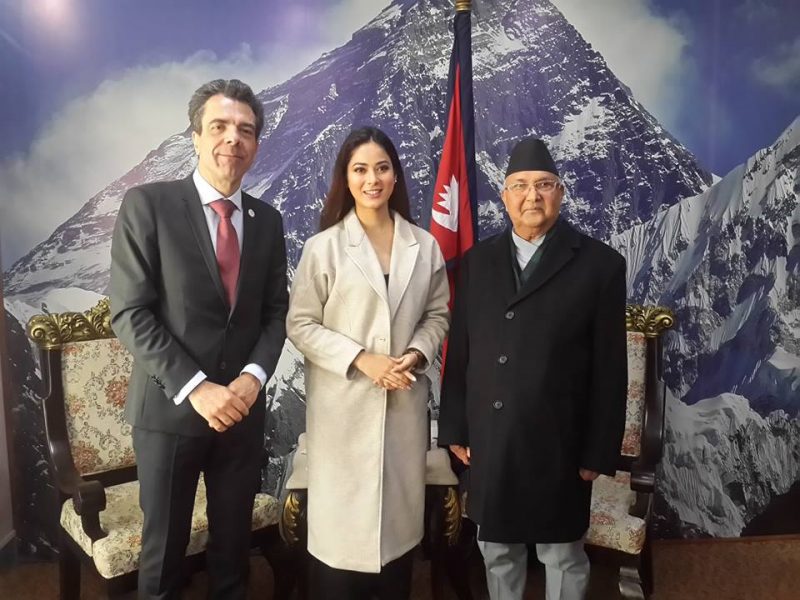
French Ambassador to Nepal François-Xavier LEGER (L), youth icon Shrinkhala Khatiwada (C) with Prime Minister K P Oli. (Photo: French Embassy)
Nepal and France share a long common history of cooperation in the domain of alpinism and is vital to the bilateral relationship.
POKHARA: The local tourism entrepreneurs have gone to Siliguri, India for publicizing Pokhara in the north-eastern region of India. The delegation comprises 22 entrepreneurs. The tourism entrepreneurs have reached Siliguri in the context of facilitating trade among the entrepreneurs between Nepal and India, and with the growing number of Indian visitors from the north-east parts visiting Pokhara every year.
The Pokhara Tourism Council has been organising such promotional tours of tourism entrepreneurs every year with the aim of further promoting tourism relations with the north-eastern region of India.
The local tourism entrepreneurs will also participate in the Bengal Travel Mart (BTM) to be organised in Siliguri from today. The mart is organised by the Eastern Himalayan Travels and Tour Operator Association (EHTOA), a common organization of the tourism entrepreneurs of the north-eastern states of India. The information about this was shared in a programme oganised in Siliguri on Monday.
On the occasion, Manager of Nepal Tourism Board’s Pokhara Office, Surya Thapaliya had shared information on the tourism in Pokhara and Nepal. He believed that the promotional programme would be beneficial both for Nepal and India.
First vice-president of NATTA Western Region Association, Sanjaya Kant Sigdel, said that a large number of visitors from the north-east region of India including Siliguri, Dooars, Gangtok, Sikkim, Darjeeling, Manipur, Assam, among other places come to Nepal through the eastern transit point Kakadbhitta and other transit points, every year.
President of Pokhara Tourism Council, Chiranjibi Pokhrel said extensive discussions would be held on various aspects of tourism business collaboration with the tourism entrepreneurs of India as part of BTM.
Pokhara Tourism Council and the EHTOA have also signed a joint memorandum five years back for promoting partnership in Pokhara’s tourism. The agreement includes increasing the professional capacity, joint publicity, business networking and conducting joint promotional programmes, among others.
CHITWAN: Preparation is underway to send samples of bodily part of dead rhinos abroad for laboratory tests in view of increasing incidents of unnatural deaths of one-horned in Chitwan National Park (CNP) and surrounding forest area.
The samples are to be sent abroad for necessary tests so as to find reason behind the death of the rare wild beast.
Twenty rhinos have been found dead as of now in the current fiscal. The Chitwan National Park has constituted a committee to put forth investigation into the death of rhinos due to natural reasons.
According to Gopal Ghimire, Information Officer at CNP, seven rhinos were found dead in the period of last one month.
Among the rhinos dead due to natural reasons, 28 were found at CNP premises and one in the area under the District Forest Office. Ghimire further shared the rhinos found dead in CNP due to other reasons except the natural ones were at the age group of 15-25. An average of rhino is 60 years. Bed Kumar Dhakal, Chief Conservation Officer, CNP said preparation is being made to send samples of rhinos, including four dead for laboratory test with the rise in unnatural death of rhinos.
KATHMANDU: The government has set an ambitious campaign to attract 2 million international tourists in 2020 with a view to branding Nepal as a major tourist destination. However, for Suraj Vaidya, National Coordinator of Visit Nepal 2020, and his team, fulfilling the government’s target could be a challenge, if not a daunting task.
The team, entrusted to accomplish the ambitious target, could feel pressurized with every tick of the clock since there is nothing like a ticking clock to get people to snap into action.
National Coordinator Vaidya and his team, including the Nepal Tourism Board (NTB), however, is enthusiastic to make it happen since they have already fastened their laces.
Tourism is one of the Nepal’s vital engines of economic growth. Considered as one of the best holiday destinations due to its exotic natural beauty, majestic Himalayan peaks, amazing multicultural aspects, and varied topographical features, the Visit Nepal year 2020 can be an opportunity to showcase Nepal as a unique destination offering sports, adventure, religious tourism and other exotic socio-cultural experiences.
Nepal, dubbed as an amphitheater for adventure enthusiasts, witnessed a significant rise of foreign tourists in 2018 with a total of 1 million 173 thousand 702 visitors coming to Nepal as per the NTB data.
Tourism Minister Rabindra Adhikari expounds the truth when he says, “Nepal has a competitive advantage due to its varied topographical features, and biodiversity.”
Nepal, dubbed as an amphitheater for adventure enthusiasts, witnessed a significant rise of foreign tourists in 2018 with a total of 1 million 173 thousand 702 visitors coming to Nepal as per the NTB data. The figure was 940,281 in 2017. “With positive signs looming, and views flooding with promising assurances from across the world, we are very much optimistic to meet the target,” Vaidya told khabarhub.com referring to the significant growth of international visitors.
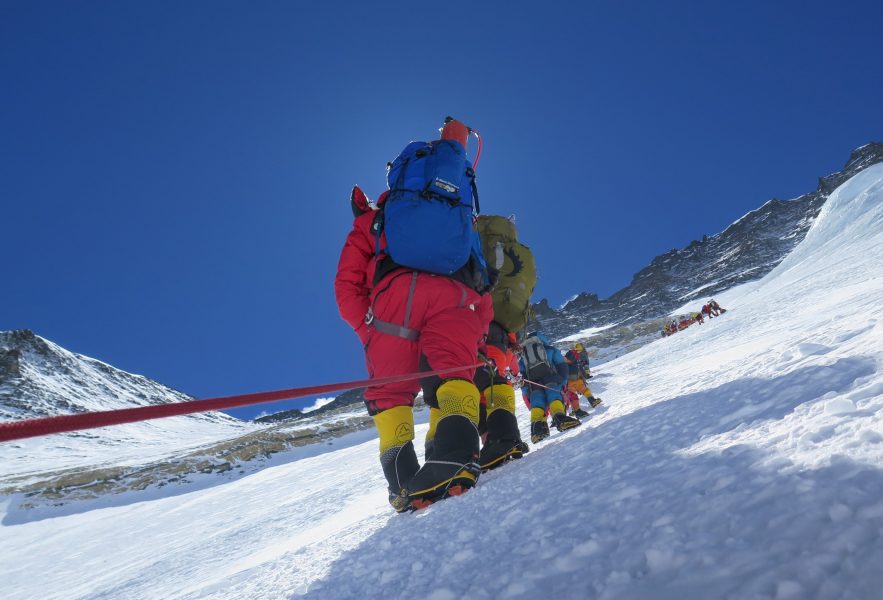
However, challenges remain. As Nepal markets its destinations, it needs to ensure that it delivers a safe, flawless, and inimitable experience to the international visitors. The government, coordinating team and the private sectors need to work both on physical and digital infrastructure development such as: roads, connectivity, hotel rooms, air and land service, including maintaining cleanliness, and controlling pollution ensuring that the visitors do not get into trouble. The construction of the Gautam Buddha Airport in Bhairahawa, and the expansion and beautification of the country’s only international airport, Tribhuwan International Airport (TIA) in Kathmandu, and the reconstruction of the major heritage sites destroyed by the 2015 devastating earthquake remains a challenging task. However, tourism minister Adhikari is hopeful that the Gautam Buddha Airport would be completed by mid-August.
Obviously, less than 300 days is not enough time to accomplish all the tasks. Vaidya, however, feels VN 2020 is going to be great since Nepal can attract three types of tourists – religious tourists, adventure/sports tourists, and investors from different countries, including India, China, Japan, among others.
“Religious tourism is increasing in countries such as India, China, Thailand, Japan, and Sri Lanka. Lumbini can be a major attraction for this category,” Vaidya suggests. According to NTB, India ranked the top with 200,438 tourists visiting Nepal in 2018 followed by China with 153,602 visitors, the United States with 91, 785 tourists, the United Kingdom with 63,086 visitors. The second category is the adventure tourists. “Nepal has plenty of adventure tourism spots to bring them here. We just need to market them,” he adds.
According to NTB, the arrivals from Sri Lanka have increased by 55.7 percent in 2018 in comparison to the last year. The arrivals from SAARC members registered a sturdy growth of 26.4 percent over the same period last year with 301,963 total tourist arrivals. “The figures are encouraging,” Minister Adhikari said.
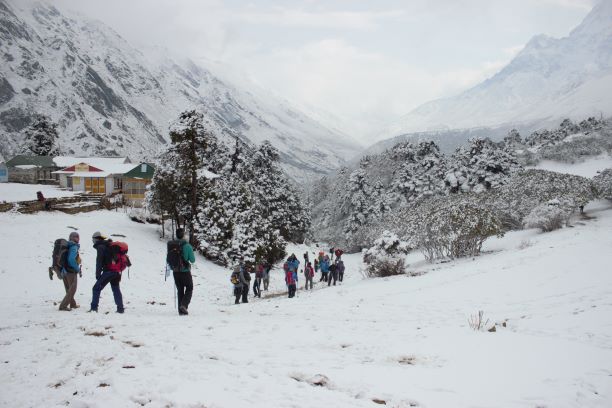
Likewise, the third type of tourists that Nepal is looking for from different countries is investors, who can have the opportunity to invest in areas such as hydropower, tourism, among other sectors, according to Vaidya. Despite all odds, Nepal holds an aura of a mystical nation filled with temples and hospitable people.
It is high time that the government and the campaigners turned up the heat challenging the limited time into making VN 2020 a success!
KATHMANDU: A total of 645 one-horned rhinos exist in Nepal, according to the record maintained by the Department of National Parks and Wildlife Conservation (DNPWC).
Chitwan National Park (CWC) is the main habitat of one-horned rhinos numbering to 605 rhinos.
Similarly, Bardia National Park has 29, Suklaphanta National Park has eight while Parsa National Park has three rhinos in Nepal. With the current success in rhino conservation, conservationists are hopeful of recovering the rhino population to a historic level.
According to the DNPWC, the number of rhinos is growing by 5% per year.
CWC is now saturated with rhinos. Those trans-located to Suklaphant and Bardiya National Park are still low in number for several reasons. Infant mortality and fighting to the death in terms of courting are some of the reasons responsible for the low rhino population.
With the current success in rhino conservation, conservationists are hopeful of recovering the rhino population to a historic level.
So far, Nepal has donated 28 rhinos including 2 pairs of rhinos to China in 2018.
Despite Nepal making headway in the fight against rhino poaching and marking zero poaching years, five times since 2011, authorities have witnessed a major setback in conservation efforts of late.
As many as 25 one-horned rhinos have died according to the report unveiled by DNPWE in the year 2017/2018.
During the year, only one was killed by a poacher while the others died of natural reasons.
In Nepal, Rhinos are mainly poached for their horns believed to have medicinal properties for traditional medicine.
Horns are also used as trophies and decorations to display social status. In Nepal, rhinos had hugely declined from 1000 to 100 during the 1950s due to habitat destruction and heavy poaching.
The number which was gradually recovering to 612 at one time in the past went down to 400 again due to poaching and a decade long Maoist insurgency (1990-2006).
If you have the urge to discover Nepal’s terrain, and understand the ecology or learn about its distinct geography, going for a trek would be the right thing to do. Unquestionably, Nepal has remained an exciting playground for adventure tourists and trekkers since the Himalayan country offers an assortment of exhilarating opportunities.
The camaraderie of the locals will add flavor to a trekker’s fervor besides getting a stunning view of the snow-capped mountain peaks. Khabarhub gives you a sketchy idea about some popular trekking destinations.
Everest Region
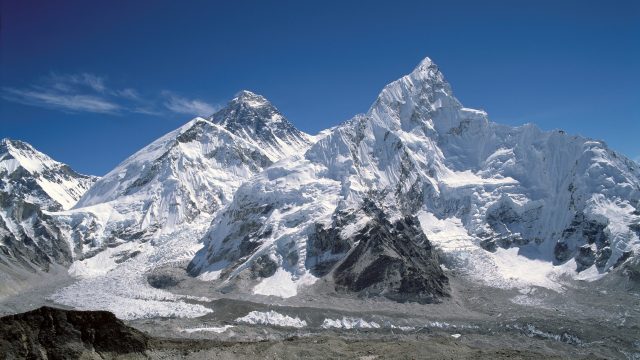
Photo: Nepal Tourism Board
A homeland to numerous soaring mountain ranges, including the world’s highest peak, the Mt. Everest, this region will mesmerize a trekker with its grandeur. Peaks like Mt. Everest, Mt. Pumori, Mt. Lhotse, Mt. Thamserku, Mt. Tawache, Mt. Nuptse, Mt. Kangtega, Mt. AmaDablam, Mt. Cho Oyu and several other peaks will leave you spellbound. Trekking to the Everest Base Camp would be enthralling since it gives you a spectacular close up view of the world’s highest mountains, as well as an opportunity to explore the Sherpa villages and their lifestyles besides coming across magnificent high passes, valleys, rivers, monasteries and Buddhist prayer flags.
Annapurna Circuit
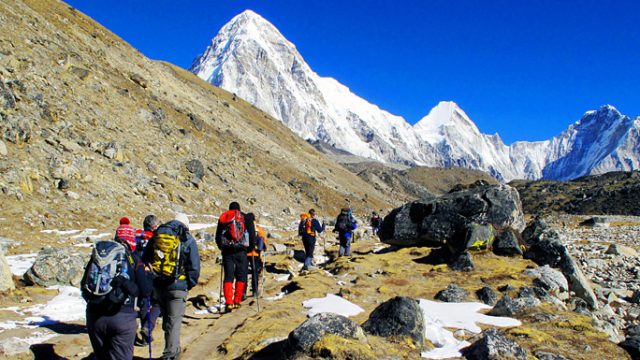
Photo: Nepal Tourism Board
Dubbed as one of Nepal’s most popular treks, Annapurna Circuit gives you a blend of adventure and pleasure with the trail traversing a variety of terrain in the Annapurna region. Trek to the Annapurna Circuit gives you an opportunity to understand and explore the rich cultural and natural diversity besides offering an amazing view of the Annapurna range, Dhaulagiri, Macchupucchre, Manaslu and LangtangHimal. Moreover, the trail offers you an opportunity to enjoy the lush valley, green high alpine, and arid peaks. And not to forget the smiling faces of the people!
Manaslu Circuit
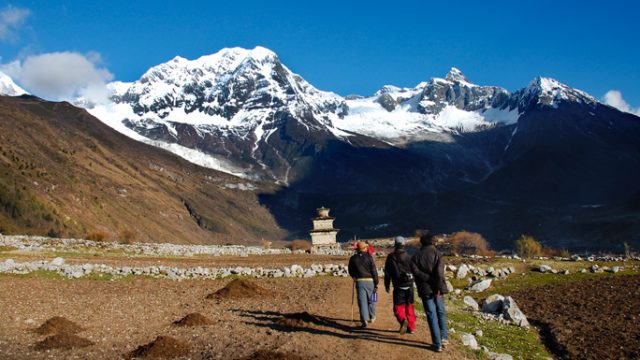
Photo: Nepal Tourism Board
The Manaslu Circuit offers you spectacular panoramas of the snow-clad peaks on the Nepal-Tibet border. The trek here goes around the gorgeous Mount Manaslu — the world’s 8th highest mountain. The profoundness of your spirits will reach the optimum high when you get through the challenging Larkya Pass, and several other mountain passes. On the way, you will find typical villages and come across diverse cultures of ancient Buddhist monasteries. The Manaslu Circuit trekking route, in fact, gives you adventurous, yet fabulous experience for trekkers.
Ghorepani Poon Hill
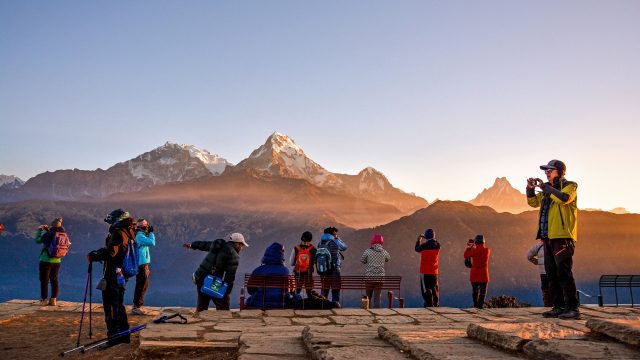
Photo: Nepal Tourism Board
Easy and short route, Ghorepani Poon Hill Trek offers you a panoramic view of the high hills, terraced farmlands as well as the beautiful rhododendron forest. More than that, the warm hospitality of the people of Gurung community adds flavor to the trip. In fact, the trek becomes relatively exciting during the spring season when the rhododendron forest is in bloomGhorepani Poon Hill trek is usually termed as the best trek in this Himalayan country to have a spectacular sunrise view over the Annapurna range and to explore the beauty of the Annapurna Region.
Langtang Valley Trek
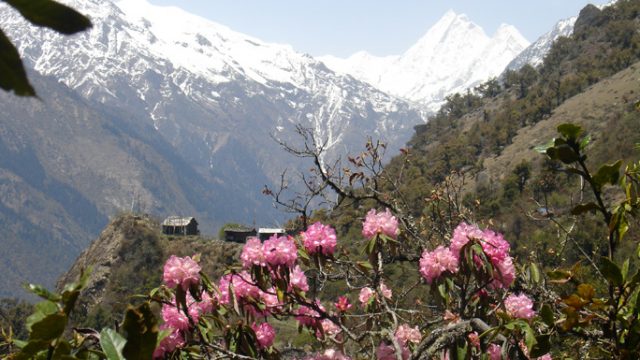
Photo: Nepal Tourism Board
What could be more exciting than to go for Langtang Valley Trek – widely admired trekking route for its diverse vegetation and cultured villages? Surrounded with tranquil rural landscape, this trek offers an opportunity to view the stunning Annapurna and Makalu peaks. Besides, the trek also makes you feel the warmth of the rich Tamang culture and hospitality. In fact, you will not miss some beautiful glaciers at a quite low altitude.
Upper Mustang
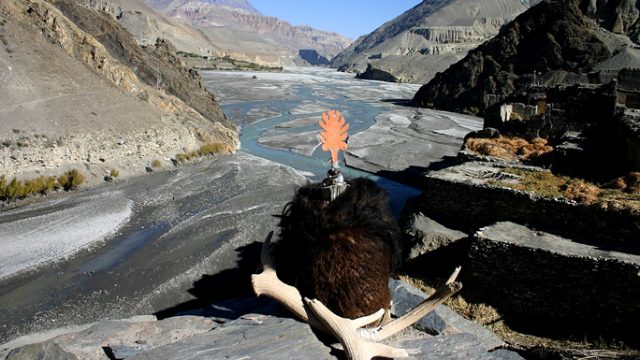
Photo: Nepal Tourism Board
Close to Tibet, the Upper Mustang offers you an opportunity to see the 16th-century Buddhist monasteries and the caves carved into sheer cliff walls. Considered a culturally and geo-politically sensitive, this was opened for trekking only from 1992. This place has an unusual terrain of a semi-arid desert. The deep ravines and rock shelves, fringed with snowy peaks add flavor to your trekking experience. In fact, this place is often termed as a ‘hidden paradise’ rich in Tibetan culture.
Kanchenjunga Base Camp
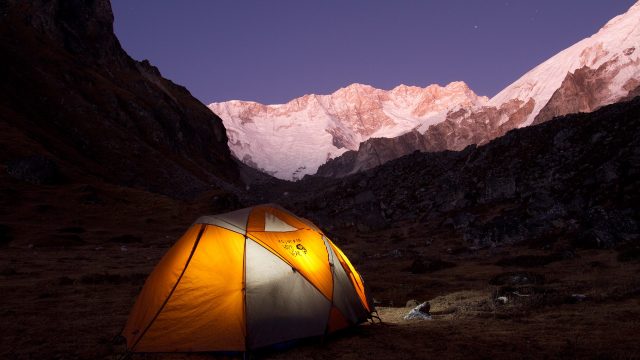
Photo: Nepal Tourism Board
Trek to the Kanchenjunga area will give you an opportunity to explore the culture and beauty of the mountain range – a home to some of the Asia’s most exotic wildlife. The trek also takes you to the high-mountain terrain on Nepal’s border with Sikkim and Tibet. The trek to this region will give an exposure to the unspoiled local culture
Annapurna Base Camp
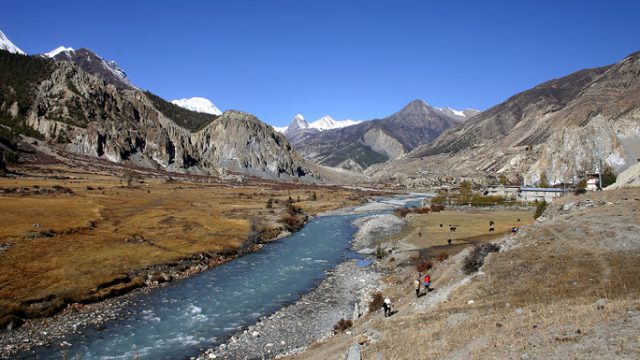
Photo: Nepal Tourism Board
Trek to the Annapurna Base Camp takes you to the base of Mount Annapurna passing through hospitable villages and picturesque valleys. A blend of superb natural scenery and rich cultural diversity, the spectacular trek offers you a close view of the peaks above 8,000 meters. Trekking to Annapurna Base Camp is a spectacular, breathtaking walk that rewards trekkers in many ways.
Gokyo Valley
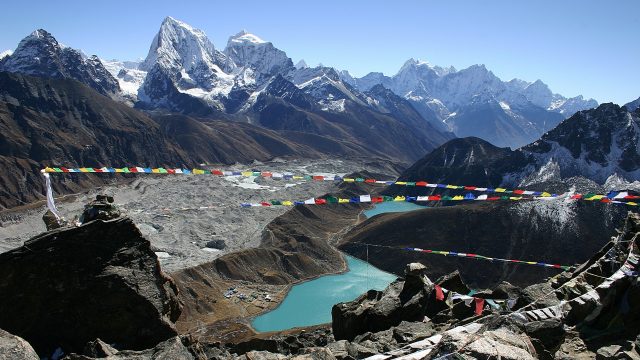
Photo: Nepal Tourism Board
Golyo Valley, Nepal’s biggest glacier and an arc of snow-mountains, is the most attractive region in the Khumbu region. The GokyoRi Trek is a trek to the Gokyo valley that passes through green forests and several suspension bridges. Its alluring side glens, turquoise lakes, and the scenic ridges enhance the trek. This offers an opportunity to view of the five Emerald Lakes together in the shadow of the majestic mountain peaks in the Gokyo Valley along with the view of the wonderful ice ridge between Cho Oyu and Gyachung located in Khumbu region.
Upper Dolpo
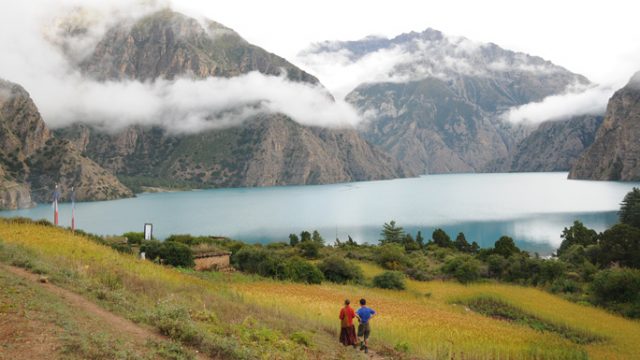
Photo: Nepal Tourism Board
Trek to the Upper Dolpo region involves long climbs and strenuous descents. Considered as a hidden gem of Nepal with its Tibetan style villages, its stunning barren landscapes, and picturesque mountain peaks displays an impressive acquaintance. The region, in fact, holds centuries-old culture untouched by the modern world. Trekking to this region needs to cross of three high passes Nagdalo La (5350m), Shey La (5000m) and Jeng La (5110m).
Nepal receives over 150 species of migratory birds each year, thanks to its rich ecological diversity. The birds travel from China, Mongolia, Korea, the Siberian region of Russia, China, Sri Lanka, India, Korea and some parts of Europe and Central Asia to avoid cold as well as for breeding.
Birds usually migrate to Nepal during winter and summer seasons. Winter migratory birds start to migrate from mid-September to the end of November. Similarly, summer migratory birds start arriving here from March to the mid of June.
Unlike other sub-tropical countries, Nepal has long summer days, giving the birds up to 14 hours a day to forage for food, a luxury they do not find in their native countries.
Birds usually migrate to Nepal during winter and summer seasons. Winter migratory birds start to migrate from mid-September to the end of November. Similarly, summer migratory birds start arriving here from March to the mid of June.
Most of the winter migratory birds that migrate to Nepal belong to duck species like mallards, ruddy shelduck, gadwall, common teal, northern Pintail, woods and piper, Greenshank, thrushes, leaf warblers, Eurasian Teal, flycatcher and the booted eagle among others. According to Krishna Bushal, Vulture Conservation Program Officer for Birds Conservation Nepal, some of these birds fly up to 9,375 meters and weigh up to 2.5 kg. These migratory birds stay in wetlands and other favorable regions across the country. They stay mainly in Koshi Tappu Wildlife Reserve, Bishajari Taal, and Ghoda Ghodi Taal. Similarly, they also nestle in Koshi and Narayani river belt and Kaligadi corridor.
Some species of the birds, migrate from the Himalayan region to the lowlands within the country during the winter season.
Bulks are various species of cuckoos, such as pied cuckoos, Eurasian cuckoos, and oriental cuckoos, Chestnut-headed bee-eater and Asian paradise flycatchers that migrate to Nepal belong to the summer migratory birds. These birds migrate to Nepal in search of food, according to Bushal. These birds need easily accessible food, good weather, and less competition during the breeding season. Unlike, winter migratory birds, they come here for breeding too. They are found in the forest, farmlands and some of them use others’ nest for shelter. In summer, at least 62 species of birds migrate to Nepal. Likewise, 50 species of birds migrate from Nepal to India during the winter seasons.
Some species of the birds, migrate from the Himalayan region to the lowlands within the country during the winter season. In recent years, due to growing urbanization, deforestation, and ecological degradation, the number of migratory birds has declined, according to Bushal. Similarly, hunting and forest fire in the summer season also adversely affects the life pattern of birds in Nepal.
BAJURA: Nepal’s far-western region, which sometimes reels from famine and drought, is astonishingly rich in natural beauty.
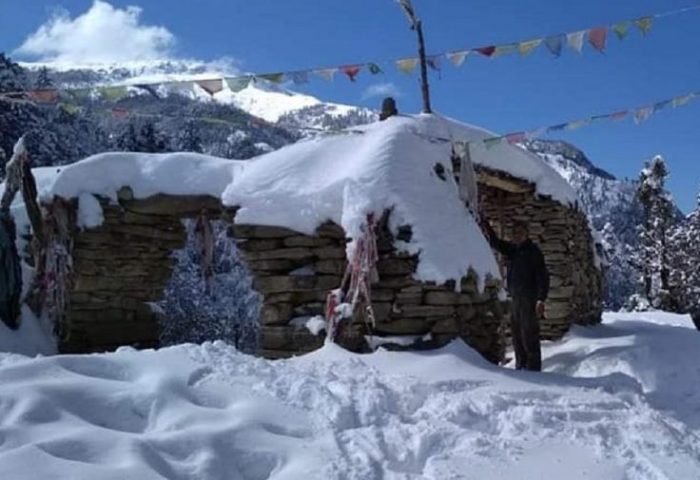
While the region is blessed with the fragrance of colorful flowers in the spring season, it is no less beautiful than Switzerland owing to the sparkling snow during the winter.
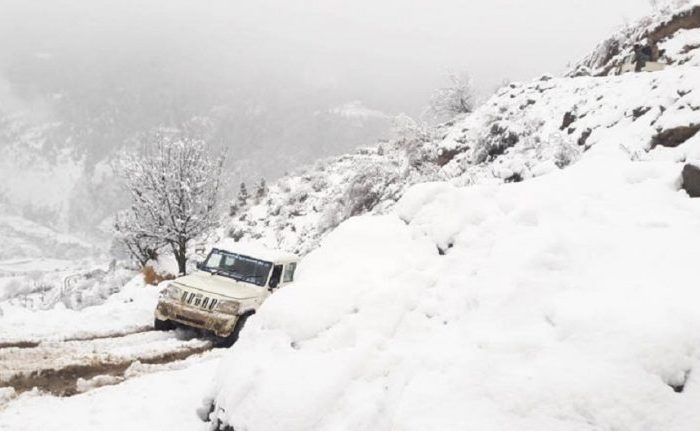
Thanks to the snowfall since last Monday, the Himalayan belt of the region is all silvery. It feels as if otherwise naked hills of the far west are decked with clean white bed sheets.
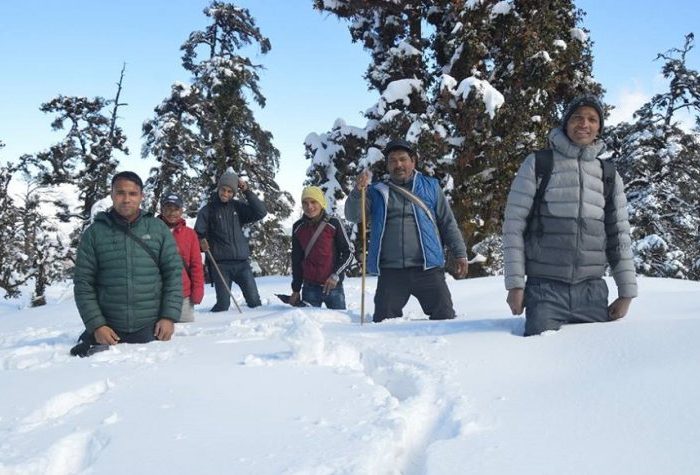
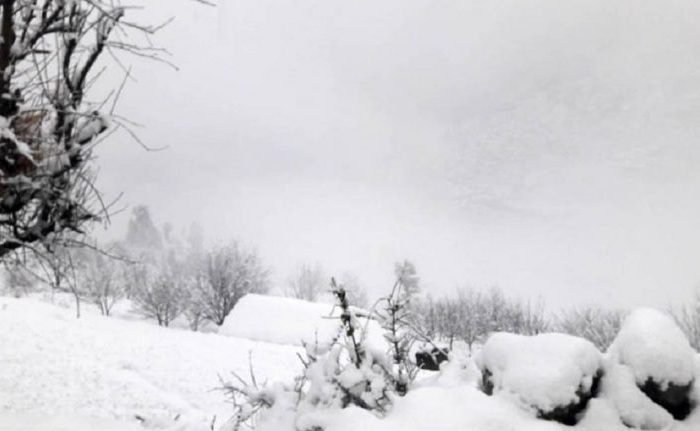
While the region is blessed with the fragrance of colorful flowers in the spring season, it is no less beautiful than Switzerland owing to the sparkling snow during the winter.