





BANKE: The Banke National Park (BNP) has put a ban on the usage of elephants for personal purpose. The BNP has made the rule following the Act related to elephant management.
Yubaraj Ragmi, Chief Conservation Officer at BNP informed, “We have stopped leasing the park’s elephants after the government’s ban. They will be used only for tasks and activities of the Park and conservation area”.
The Park has four elephants at present and domestic tourists would be charged Rs 5,000 each for a ride of six hours. Likewise, the charge would be Rs 10,000 each for tourists of SAARC countries, and Rs 20,000 each for tourists of other foreign countries, said Bishnu Thapaliya, Information Officer at the BNP.
Climbers from across the world dream of scaling the top of the world, Mt. Everest. However, achieving the daring feat is challenging. But not to the Sherpas, people from an ethnic community of Nepal in the Himalayan region. In fact, Sherpas are synonymous to the Everest.
While it may be a passion to many climbers, scaling the Everest has been ancestral profession to the Sherpas who are working as porters and guides to mountaineers for a long time.
While mountain climbing is nothing new to Sherpas, Kami Rita Sherpa has carved a niche in this sector. Incredible it may sound but he has climbed Mt. Everest, the world’s highest peak for 22 times — between 13th of May 1994 to 16th May 2018.
This 49-year-old of Thame, Solukhumbu first ascended the highest peak on 13 May 1994. Since then there is no looking back for him.
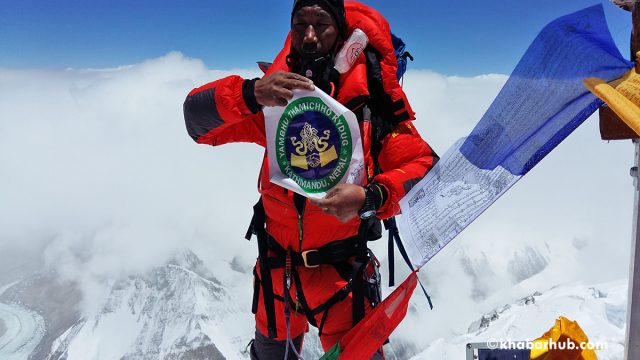
He has also climbed Annapurna IV in 1996, Cho Oyu 8188m for 8 times from 2001 to 2011, LhoTse 8,516m in 2011, Mt. K2 (8,611m) in 2014, and Manaslu (8,163) in 2017.
Born on 19 Jan 1970, he has so far made 34 successful summits over 8000m peaks.
Kami Rita is currently working as a senior climbing guide at Seven Summit Treks and 14 Peak Expedition P. Ltd, sister companies.
Ask him his future plans and he would say: “I want to climb Mt. Everest for another five times.”
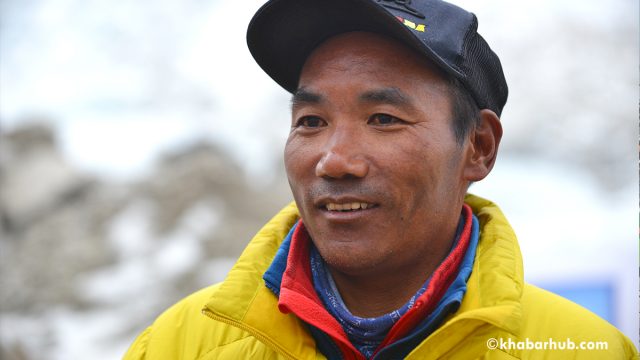
“I will continue to climb until my health permits me,” he said His village folk call him “record-holder Kamirita” since there are quite a few of his name in his village.
Kami started his job as a porter at the age of 12, and he succeeded in reaching atop the Mt. Everest when 24 on the 13th of May, 1994.
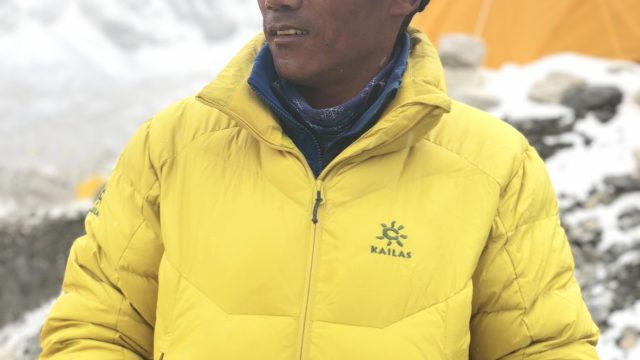
The government allows a permit of 75 days for Everest Summiteers. They stay at Sagarmatha Base Camp for 35 to 40 days before setting off for the climb.
It is necessary for a climber to stay at the base camp for acclimatization. In the camp, they sing, dance, cook and enjoy, says Kami. According to him, they take the climbers to Camp One, Camp Two, and Camp Three, and return to the Base Camp. Till camp two, we cook ‘Dal and Bhaat’, Kami Rita said.
“Rather than making or breaking records, my aim is to attract foreign climbers specially to the Mount Everest and the snow capped Himalayas of Nepal contributing to its tourism development,” he said revealing his motive behind his repeated mission to world’s peak.
Kami says he earns Rs. one to 1.2 million while climbing the Mt. Everest.
KATHMANDU: For adventure seekers and fun lovers, paragliding, which has come into operation at Chapakharka in Godavari, would be a perfect experience.
All one needs to do is to drive all the way to Godavari, which is 15 kilometers from Kathmandu, and then to Chapakharka, which is 5 kilometers from there.
The 15 to 30 minutes of floating in the air will give a lifetime experience at Rs 6,500 per flight from where one can see the entire Kathmandu Valley, the surrounding mountain peaks, and the green hills. However, a foreigner has to pay Rs11,300 for the same time.
The paragliding with an investment of around Rs30 million has been operated keeping in view the Visit Nepal 2020 campaign, which aims to attract over two million tourists.
Though the paragliding began last year in December, the service was disrupted due to various reasons.
According to Kathmandu Paragliding and Hand-gliding Pvt Ltd, the operators, some three hundred flights have been conducted so far. It operates 25 flights a day with six gliders.
The paragliding takes place from 2,100 meters above Godavari and the landing takes place at Rachantar, which is at an altitude of 1,600 meters.
Nepal and India are set to sign an agreement on biodiversity conservation, including the transboundary conservation of the rhino, Bengal tiger and Asian elephant.
The agreement is expected to be signed before India’s parliamentary elections in April, according to the Indian media.
According to media reports, the Valmiki Tiger Reserve in India runs into Nepal’s Chitwan National Park, and Parsa National Park. Likewise, India’s Dudhwa Tiger Reserve in Uttar Pradesh shares a border with Shuklaphanta National Park in Nepal.
Nepal-India border stretches more than 1,850 kilometers includes several transboundary wildlife habitats. The agreement is expected to manage the transboundary landscape.
According to media reports, the Valmiki Tiger Reserve in India runs into Nepal’s Chitwan National Park, and Parsa National Park. Likewise, India’s Dudhwa Tiger Reserve in Uttar Pradesh shares a border with Shuklaphanta National Park in Nepal.
The Indian media quotes S.P. Yadav, member secretary of Uttar Pradesh’s State Biodiversity Board as saying that Nepal and India do have any formal agreement at present.
The agreement is expected to lead to the better conservation of rhinos, tigers and elephants. It is also expected to help immensely in “tackling illegal trafficking”.
According to Yadav, the agreement will be a formal instrument that will lead to better transborder cooperation.
“Nepal and India have been working in close coordination,” Man Bahadur Khadka, director-general of the department of national parks and wildlife conservation at Nepal’s Ministry of Forests and Environment said.
Likewise, Nakul Chettri, a senior biodiversity specialist with the International Centre for Integrated Mountain Development (ICIMOD), in Kathmandu said the agreement would be a welcome step.
The agreement will help in cementing the bilateral cooperation and strengthen the management of important transboundary wildlife habitat, he viewed. Chettri said it will be a win-win for both the countries.
“Nepal and India have been working in close coordination,” Man Bahadur Khadka, director-general of the department of national parks and wildlife conservation at Nepal’s Ministry of Forests and Environment said.
According to him, all work regarding the agreement have been complete adding that the agreement would focus on biodiversity conservation, wildlife habitat management, tiger conservation and protection.
Meanwhile, the agreement is expected to put an “emphasis on cooperation” for the conservation and protection of tiger. According to the 2014 tiger population census, India is home to 2,226 tigers. Similarly, according to latest estimates, Nepal’s tiger numbers has been put at around 235, up from 120 in 2009.
KATHMANDU: Nepal Tourism Board (NTB) has appointed tourism entrepreneurs Pampha Dhamala and Biplav Poudel as its board members. Rabindra Adhikari, Minister for Culture, Tourism and Civil Aviation, has appointed Dhamala from Dhading and Poudel from Pokhara to the posts.
Dhamala is currently serving the Langtang Ri Trekking Expedition Company in his capacity as managing director. Poudel is the executive director of Hotel Barahi, Barahi Jungle Lodge and Sarangkot Mountain Resort and also the chairperson of Pokhara Ultralight.
Sundarijal-Chisapani-Nagarkot-Kathmandu
If you have a short time and want to go for a trek, the Chisapani-Nagarkot Trekking is the best option for you. You can view the mountains, sloppy hills, plain lands, and other breath-taking views.
Sundarijal is considered the doorway of trekking routes to Nagarkot, Helambu, Gosainkunda and the Langtang National Park. Talking about the Shivapuri National Park, it will blessed with a temperate and subtropical climate which is also rich in wildlife and plants such as oak, pine and rhododendron as well as varieties of orchids, mushrooms, butterflies, bird species, rare animals like jungle cats, sloth bear, leopard, monkeys etc.

Photo: Nepal Tourism Board
Here is the synopsis of trekking
Day 01: Kathmandu – Sundarijal – Chisapani (Walking distance 4-5 hrs)
The trek starts from the Sundarijal. There is an adequate transportation facility from Kathmandu to reach Sundarijal, situated at the altitude of 135 meters. On the top of the Shivapuri ridge at an altitude of 1895 meters, you will find the Tamang settlement. From there, one can have a spectacular panoramic view of the Kathmandu Valley. After passing through an army camp, beyond Mulkharka the trekking enters the Shivapuri National Park. The hiking of the day ends at Chisapani (2300m).
Day 02: Chisapani – Nagarkot (walking distance 5-7hrs):
After a light breakfast at Chisapani, one can follow the flat trails for about 3 hours and can descend down to reach to Chowki Bhanjyang. From the Chowki Bhanjyang, the route to Nagarkot has several ups and downs. After a trek of around 2 hours, once can reach Nagarkot — situated at an altitude of 2175 m. Nagarkot provides the grand stand panoramic views of the Himalayas. From there, one can see peaks like Lhotse (8516 m.), Cho Oyu (8201 m.), Makalu (8463 m.) Manaslu (8163 m.), among others.
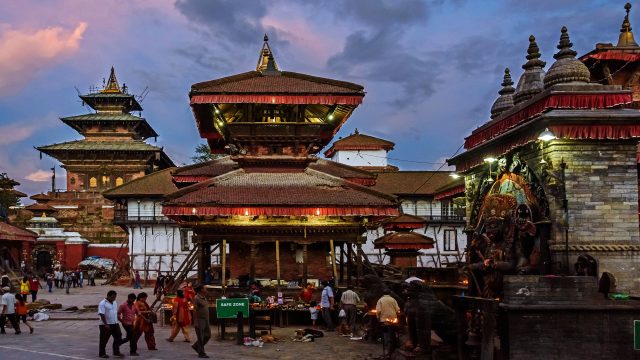
Photo: Nepal Tourism Board
Day 03: Nagarkot – Changunarayan – Kathmandu (Walking distance 2-3 hrs):
If you want to visit one of the famous temples located in Bhaktapur, Changunarayan Temple — listed in the world heritage site — is another option. It is believed that this temple was constructed in the 15th century. After visiting this temple, one can come down to Bhaktapur to have a stroll of the Bhaktapur Durbar Square too, which is full of arts and culture. There are many monuments of historical significance such as the Five Story Temple known as Nyatapola, 55 Window-Palace, Golden Gate, Lion Gate, and several other places to see. From Bhaktapur, one can come back to Kathmandu.
JIRI: As many as 700 tourists stranded at Kalinchowk of Dolakha district after a snowfall have been rescued by security personnel.
A joint team from Nepal Police and Armed Police Force have rescued nearly 120 tourists. The tourists reached Kalinchowk to offer prayers at Kalinchowk Bhagawati Temple were stranded after sudden snowfall since Saturday evening.
The 22-member rescue team led by police inspector Madhav Prasad Kafle brought the stuck tourists to safer places. The rescue continued till Sunday evening.
KATHMANDU: Tourist arrivals in January have increased by 25.4 per cent as compared to the same month in 2018. Nepal has welcomed 91,793 tourists in January 2019.
In this month, a total of 15,343 Chinese tourists, including Taiwan came to Nepal, according to Nepal Tourism Board (NTB). China contributed a total of 13,688 tourists while a total of 1,655 tourists came from Taiwan region.
Similarly, 14,650 Indian tourists visited Nepal in January. Thailand, the United States and South Korea hold the third, fourth and fifth positions respectively for contributing the tourism in Nepal.
In 2018, Nepal received over 1.1 million tourists, according to the NTB. It was the first time that Nepal witnessed more than 1 million tourists in a year in its history.
CHITWAN: The 13th edition of the Sauraha Food Festival kicked off at Sauraha on Tuesday in a bid to promote tourism and food.
Inaugurating the festival, former minister Surendra Pandey said that the event will help in boosting tourism of Chitwan. He expressed the hope that the festival would be able to attract a significant number of visitors, both internal and external.
On the occasion, he informed that the construction of a city hall for the development of Sauraha has been started.
Restaurant and Bar Association, Sauraha chapter organized the event coinciding with the Valentine Day, which is observed on February 14.
The festival organized at local Sisuwal playground features 50 different kinds of foods and five display stalls, according to festival coordinator, Dhruba Giri.
The event, which will continue till Friday offers special cuisines of Tharu community such as chichar and ghongi. Other attractions of the festival include volleyball competition, love letter writing, and best cuisine competition.
KATHMANDU: Nepal has participated in the Travel and Tourism Fair (TTF), Chennai 2019 as part of the tourism campaign efforts.
Nepal Tourism Board (NTB) along with thirteen private companies promoted and highlighted Nepal in the three-day TTF that concluded on Sunday.
According to NTB, the TTF Chennai edition concluded with productive participation of 125 exhibitors from eight countries, 19 Indian States and Union territories.
Around 6,000 visitors visited the fair in which Nepal is a partner country. Visitors from Goa, Andra Pradesh, Himanchal Pradesh, Gujarat, Jharkhanda, Odisa, Kerala, Lakshadweep, and the host state Tamil Nadu took part in the show, NTB stated.
Meanwhile, it should be noted that Nepal welcomed 1,273,072 visitors in 2018. This means that India alone contributed 17.8 percent of the total number of arrival.
Nepal Pavilion attracted a lot of visitors in the fair. Visitors eagerly showed interest about Kailashnath and Muktinath temples.