





KATHMANDU: The country has seen an influx of over 200,000 tourists in two months alone, a 33 percent up as compared to the same period last year, according to the Department of Immigration. Altogether, 216,214 tourists visited the country in January and February (91,793 in January and 97,694 in February).
A total of 163,694 tourists had visited the country in the same period last year. The tourist inflow in the two months saw a rise by 92.5 per cent in Indian tourists as compared to the same period last year. Likewise, SAARC tourists surged by 85 per cent, and Chinese tourists by 5.3. Tourist influx from European countries including the United Kingdom, Germany and France increased 8.7, 27.9 and 7.6 per cent respectively. In February alone, 7,133 tourists from the United States of America visited Nepal, which is five percent increment than last year.
Dipak Raj Joshi, chief executive officer of the Nepal Tourism Board, credited it to various promotional activities carried out by the Board and the private sector for the increment. Additional tourism promotional program would be launched to make the government’s announced ‘visit Nepal year 2020’ a success, he said.
KATHMANDU: Visit Nepal Year-2020 program was marked in Europe. The program was inaugurated in Berlin of Germany on Saturday. Nepali Ambassador to Germany Ramesh Prasad Khanal and Executive Officer of Nepal Tourism Board Dipak Raj Joshi jointly inaugurated the program amidst a function in Berlin.
More than 300 people were present at the event including Tourism Ministers of Sri Lanka and Jamaica, according to a statement issued by the NTB. On the occasion, Ambassador Khanal appealed to all for their support in making the VNY-2020 successful as per its objective.
NTB CEO Joshi said Nepal was speeding up tourism infrastructure development to welcome two million tourists in 2020.
Dreams can be fulfilled if you have the burning desire. In fact, all journeys begin with a dream. For many, climbing the top of the world, Mt Everest could be a dream while some people might dream of reaching to the foot, the Everest Base Camp (EBC) at an altitude of 5,364 meters.
Reaching to the Everest Base Camp is now an achievable dream for those who want to glimpse the 8,848 meters summit. The EBC now has become one of the most popular adventure tourism destinations.
It will be a super adventure full of exciting moments, breathtaking snowy peaks, stunning glaciers, ancient monasteries, and ice falls, as well as the Sherpa culture and tradition.
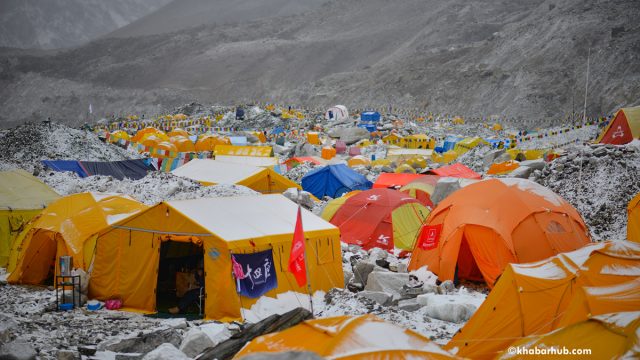
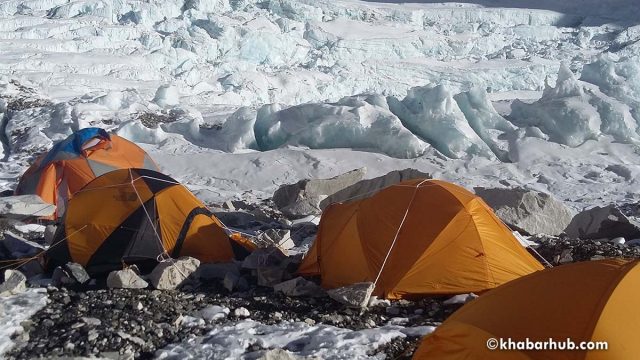
Tents at the Everest Base Camp. Climbers stay at the tent for around two months in each spring season.
Trek to the EBC can be enticing making it a lifetime experience for trekkers since this has been in the high priority list of trekkers.
Trekkers, however, cannot halt at the EBC, which is one of the most popular trekking routes in Nepal’s Himalayas. They have to return from there while climbers stay there for days before climbing the Everest.
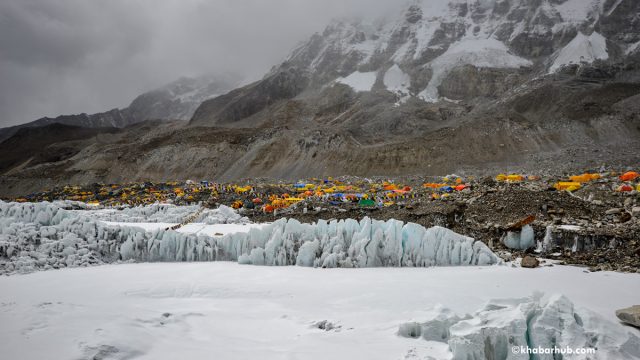
The EBC as seen from the Khumbu Icefall. In each season, around 2,500 trekkers and climbers come to the base camp.
Thousands of trekkers visit the EBC every year. Trekkers wishing save time and energy fly to Lukla, the gateway to Everest, from Kathmandu.
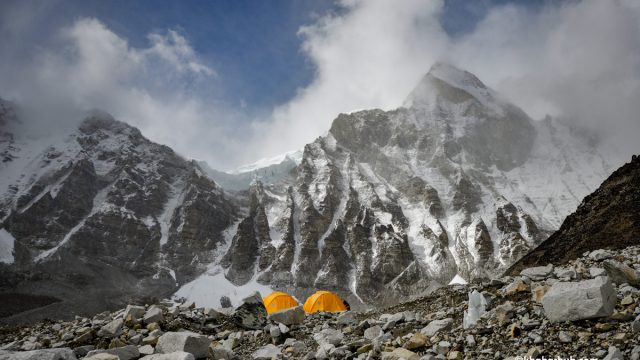
Tents at the EBC. Mt. Lingtren (6,749 m) is seen at the backdrop. Each tent accommodates only two persons.
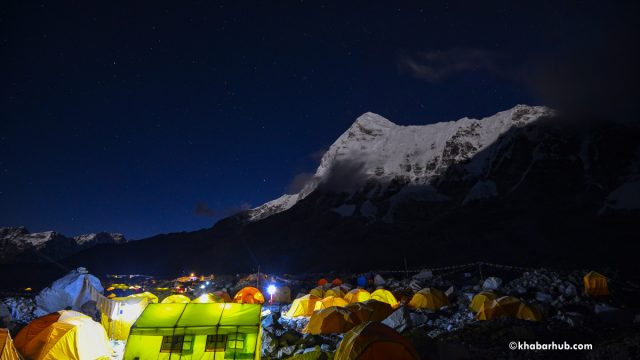
Tents at night. Mt. Pumori (7,161 m) is seen very close. The temperature at the EBC at night deeps down to a minimum of minus 20 degree Celsius.
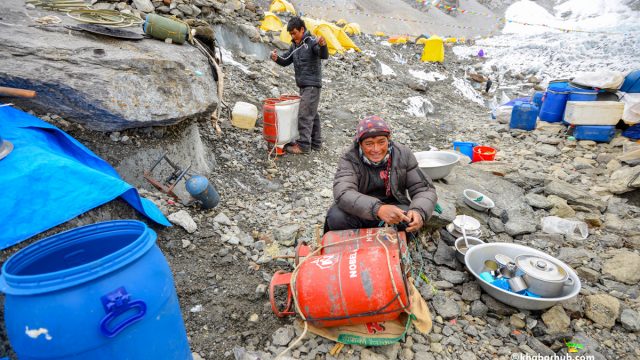
Porters are seen delivering gas cylinders at the base camp. Trekkers started using gas cylinders to cook food since the last one decade. The cylinders are also taken to the Mt Everest Camp 2.
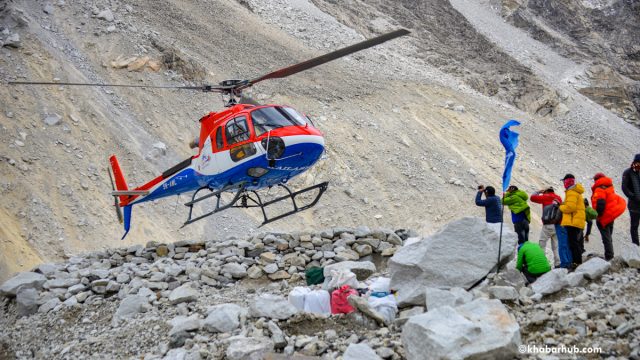
Helicopter is seen at the EBC. Trekkers also prefer choppers for viewing the Everest. Helicopters are also used in rescue operations.
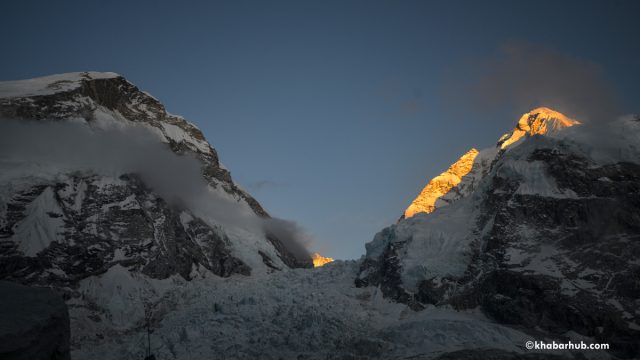
Sunrise seen at the ridge of Mt. Nuptse (7,861 m).
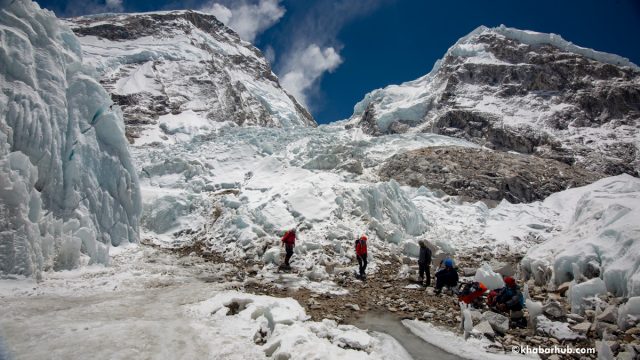
Trekkers, climbers making a round of the Khumbu Icefall as part of the expedition. Before climbing the Mt. Everest, each climber needs to make at least two rounds of the Khumbu Icefall.
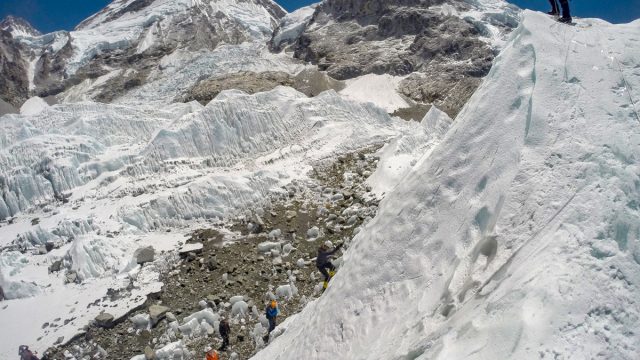
Climbers undergo training at the base camp before making their final climb. Climbers learn to use gear and equipment in the training.
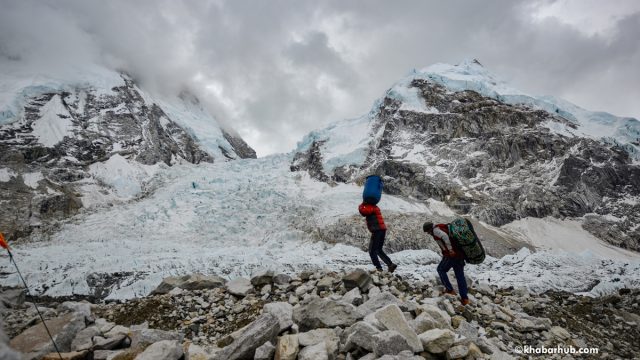
Porters carry the stuff back to the helipad.
KATHMANDU: A trekking guide died while the other went missing after being buried by an avalanche that occurred at Kyangdi of Nisyang Rural Municipality-1, Manang district.
According to Inspector Shrawan Kumar BK of District Police Office, Manang, the deceased is identified as Ajaya Dhakal of Dhading while Netherlander Vincent Bloom is still missing in the snowslide.
Dhakal and Bloom were returning home after completing an arduous Annapurna trek when the accident took place.
Dhakal’s body was recovered on Friday evening and will be handed over to his family after postmortem while the search for Bloom is underway, said BK.
POKHARA: Pokhara Metropolitan City (PMC) has withdrawn its decision to halt the operation of paragliding companies after the latter agreed to clear their long overdue arrears.
With the decision, the paragliding companies will continue their flights as usual.
The PMC had warned to halt flights of all the paragliding companies from today if they did not clear their dues. They have not cleared their dues for the last three years.
The paragliding entrepreneurs agreed to clear their dues in a meeting held between Civil Aviation Authority of Nepal, PMC and Nepal Paragliding and Hang Gliding Association.
With the agreement, each company will pay Rs 86,000 within a week, said Rana Bahadur Thapa, chairman of MPC-18. Over 60 paragliding companies have been operating flights in Pokhara.
SANYA: White-browed crake, a rare bird species, has been spotted at a wetland park in Sanya City, south China’s Hainan province.
White-browed crake is a small-billed bird around 20 cm long, with distinctive markings on the head and white eyebrows. They usually live in subtropical or tropical mangrove forests and can be found in Australia, Brunei, Cambodia, Fiji, Indonesia, Malaysia, Thailand and China.
The rare bird’s conservation status has been classified as LC (least concern) on the International Union for Conservation of Nature Red List of Threatened Species. Veteran bird-watcher Lu Gang said that the bird’s presence in Sanya indicated that local environmental protection efforts were bearing fruit. Sanya has been improving the ecology of its inland wetlands and coastal waters over the years. (Xinhua)
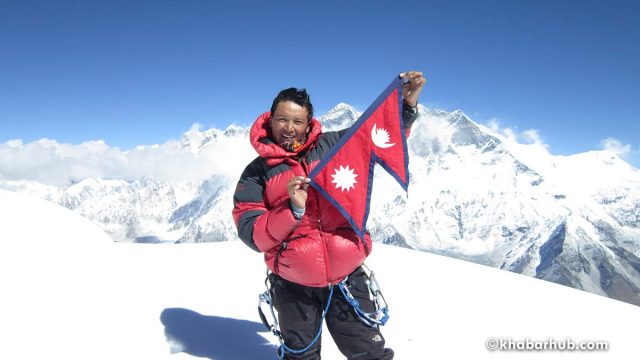
Jangbu Sherpa, who has climbed the Mt. Everest for 15 times so far, reminisces a ‘touching’ moment what one of the American climbers had told him once while ascending the world’s highest peak.
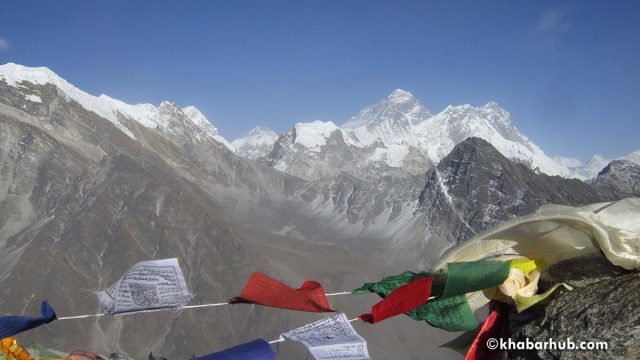
Sipping hot simmering coffee at Camp 2, and looking all around, the American climber had then told him, “Jangbu, see you have gold everywhere!”
This remarks touched Jangbu. “That was a metaphoric articulation. But, it was so striking that the expression remains itched in my mind ever since,” Jangbu shared his experience. In fact, the Everest has always been magical for him with mesmeric qualities. “Yes, Nepal’s mountains are as precious as gold,” he emphasizes.
What captivates him to the dreadful climbing time and again? “It’s the white towering peak,” pat comes the reply. He adds, “Making trips with summiteers from different parts of the world gives me a sense of satisfaction blended with pleasure.”
For Jangbu who is a famed Sherpa guide and an instructor, climbing Mt Everest is a never ending dream. Therefore, he is set for the 16th ascent, this spring. Jangbu, 37, has been guiding foreign climbers for the last 18 years since he first ascended the world’s highest summit in 2003 as a porter and helper at the age of 21.
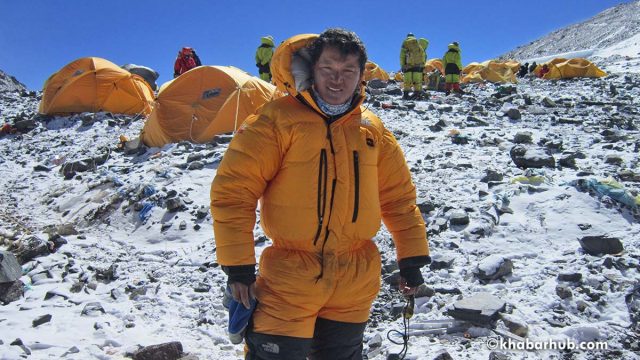
Now, he is a trained guide who leads countless treks and climbs with his clients, mostly from America, Europe and Australia.
What captivates him to the dreadful climbing time and again? “It’s the white towering peak,” pat comes the reply. He adds, “Making trips with summiteers from different parts of the world gives me a sense of satisfaction blended with pleasure.”
According to Jangbu, Nepal’s high mountains have always lured them (foreigners) since conquering the Everest is a lifelong dream for any climbers.
This season, he will be joining hundreds of climbers from several countries at the Base Camp to make a bid for the 8,848 meters tall summit.
“Yes, I am excited to climb the Everest for the 16th time this season,” an enthusiastic Jangbu said adding that the death rate in the expedition has declined in recent times. Reason: the experience gained by the climbers and the guides.
He is, however, concerned about the waste littered all around the base camps, which according to him has been creating problems giving the area a filthy look. He suggests the government needs to organize a cleaning campaign on an annual basis by entrusting at least 10 Sherpas for the task.
He is equally concerned about the government’s ambitious plan to attract at least 2 million tourists in 2020. “Merely printing advertisement t-shirts and wearing them does not work. Nepal Tourism Board (NTB) and the government should focus more on publicity campaign,” suggests the veteran climber.
KATHMANDU: The Kathmandu Valley has received heavy rainfall this morning. The freezing cold compounded by snowfall has forced Kathmanduites to stay indoors.

A view of snowfall from Country Villa Hotel Nagarkot. Photo courtesy: Rohit Phuyal
Nagarkot, Shivapuri, Tarebhir, Chandragiri, Daman including Kathmandu Valley have received rainfall along with snowfall this morning.

A view of snowfall from Country Villa Hotel Nagarkot. Photo courtesy: Rohit Phuyal

A view of snowfall from Country Villa Hotel Nagarkot. Photo courtesy: Rohit Phuyal

A view of Chandragiri covered in snow. (Photo courtesy: Ghamaraj Luitel’s Facebook)
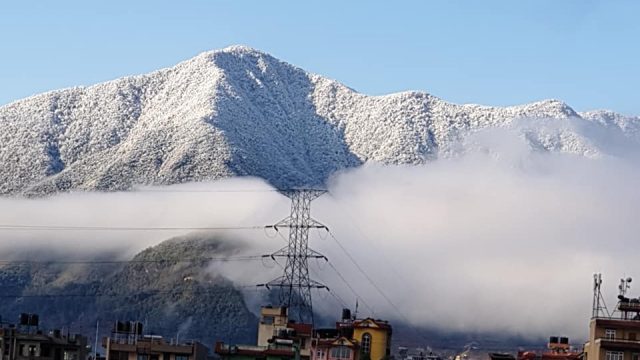
A view of Chandragiri covered in snow. (Photo courtesy: Ghamaraj Luitel’s Facebook)
Manang and Mustang districts also witnessed snowfall yesterday.
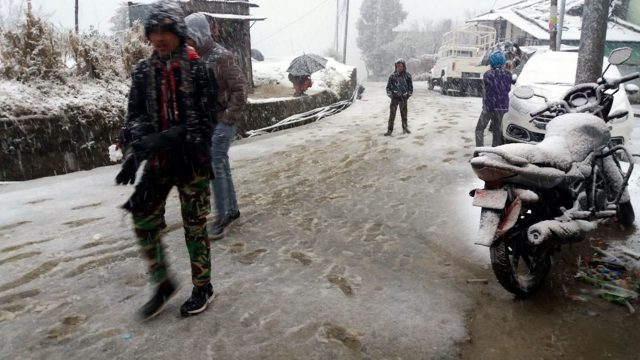
Photo: RSS
KATHMANDU: Central zoo of the country has constructed new and advanced structures for animals. The zoo has been constructing a new module of shelter depending upon animals.
Lina Chalise, Information Officer at the Zoo said that a new shelter with air-conditioned facility is being built for the red panda. The construction of new homes for blue bull, jackal and the crane is in progress.
The visitors will have an opportunity to see the blue bull after the construction of the shelter for it. Besides, works to upgrade a walkway meant for visitors are underway. The Zoo has an area of six hectares. There are 1,219 wildlife of 127 species in the Zoo now.
Last year, the Central Zoo collected Rs 1.4 million from visitors. It charges Rs 50 per head under 12 as entry fee; Rs 100 for students; Rs 150 for public; Rs 220 for visitors from the SAARC and Rs 750 for visitors from other countries.