





KATHMANDU: Nepal ranks 45th in the mobile data pricing among 230 countries across the globe. According to a survey recently carried out by price comparison site cable.co.uk, Nepal has cheaper mobile data pricing compared to US, UK including other European nations.
The cheapest mobile data is available in India with US $0.26 per GB followed by Nepal with US $2.25 per GB. The cheapest price of mobile data in Nepal is US $0.32 (Rs 37.03) per GB while the dearest price is US $6.43 (Rs 734.50).
The survey of average mobile data price in Nepal was based on 27 different data package schemes provided by telecom companies. The sample data had been collected on November 15, 2018.
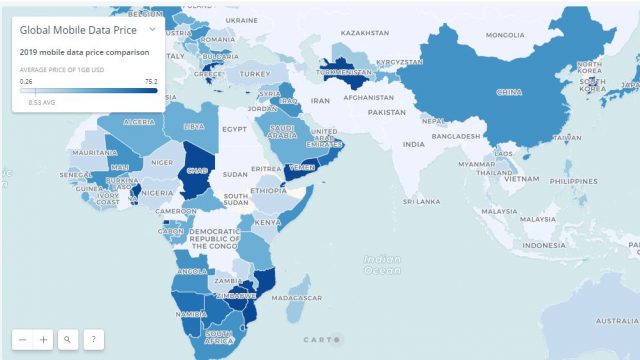
Similarly, south Asian countries Sri Lanka and Bhutan have cheaper data price than Nepal. Sri Lanka stands in 7th position with US $0.78 per GB while the cost of average mobile data is US $1.25 per GB in Bhutan (18th).
Likewise, the UK ranks 136th in the list with an average data price per GB $8.53. The USA ranks 182nd with an average data price $12.37 per GB.
Asian nations make up a half of the top 20 cheapest countries, with only Taiwan, China and South Korea charging more than the global average. The research looked at SIM-only deals and included a range of packages from all the providers in each country.
Top five nations (average global price per GB):
Last five nations ( average global price per GB):
KATHMANDU: China has banned number of its website citing the inappropriate contents for the country.
China has banned most of the websites of social media including Google. Similarly, there is no access of BBC, New York Times, Boomberg, Reuters, Times and other international news media in China. So far, China has blocked 10,000 domain names under the country’s internet censorship policy, which prevents users from accessing proscribed websites from within China’s territory.
Here is the list of some websites banned in China.

(Agencies)
KATHMANDU: The House of Representatives (HoR) today endorsed the Bill designed to amend Some Nepal Acts, 2075.
Minister for Law, Justice and Parliamentary Affairs Bhanu Bhakta Dhakal presented the Bill seeking its passage during today’s meeting of the HoR.
Today’s meeting also approved unanimously a proposal seeking deliberations on the Bill along with the report of the Law, Justice and Human Rights Committee.
Minister Dhakal said the bill was necessary to make the existing laws compatible to the new Constitution. The HoR will meet again at 3:00 pm on Friday.
KATHMANDU: The government is mulling to install a national security printing plant at the Information Technology Park.
Gokul Prasad Baskota, Minister for Communications and Information Technology, informed that the IT Park, being a national pride project, will have a security press.
Baskota informed that currency notes, passport, postage stamps, and digital cards would also be printed in the IT Park.
In the first phase, security print will be based on paper and later equipped with technology and plastic card based printing, he said at a press conference in Banepa.
Baskota informed that currency notes, passport, postage stamps, and digital cards would also be printed in the IT Park.
On the occasion, he claimed that development activities have accelerated across the country. “Be sure, development pace won’t be slowed now at any cost,” he assured the people asserting that roads, schools, universities, hospital, and technology would contribute to the prosperity of the country.
For the holistic development of Banepa municipality, Rs 60 million has been allocated and additional Rs 40 million would be provided later, according to him.
LONDON: Instagram has agreed to ban graphic images of self-harm after objections were raised in Britain following the suicide of a teen whose father said the photo-sharing platform had contributed to her decision to take her own life.
The call for changes was backed by the British government after the family of 14-year-old Molly Russell found material related to depression and suicide on her Instagram account after her death in 2017.
Instagram chief Adam Mosseri said Thursday evening the platform is making a series of changes to its content rules.
He said: “We are not where we need to be on self-harm and suicide, and we need to do more to protect the most vulnerable in our community.” Mosseri said further changes will be made.
“I have a responsibility to get this right,” he said. “We will get better and we are committed to finding and removing this content at scale, and working with experts and the wider industry to find ways to support people when they’re most in need.”
The call for changes was backed by the British government after the family of 14-year-old Molly Russell found material related to depression and suicide on her Instagram account after her death in 2017.
Her father, Ian Russell, said he believes the content Molly viewed on Instagram played a contributing role in her death, a charge that received wide attention in the British press.
The changes were announced after Instagram and other tech firms, including Facebook, Snapchat and Twitter, met with British Health Secretary Matt Hancock and representatives from the Samaritans, a mental health charity that works to prevent suicide. Instagram is also removing non-graphic images of self-harm from searches.
Facebook, which owns Instagram, said in a statement that independent experts advise that Facebook should “allow people to share admissions of self-harm and suicidal thoughts but should not allow people to share content promoting it.” (Associated Press)
MOSCOW: Russian news reports say that Google has agreed with national authorities to delete links to websites banned in Russia.
Last December, Roskomnadzor fined Google 500,000 rubles ($7,600) for failing to delete links to the banned sites. It threatened to cut access to Google if it fails to comply with the demand.
The daily Vedomosti reported Thursday that Google has reached an agreement with the Russian state media oversight agency, Roskomnadzor, to regularly receive updated lists of banned sites and delete links to them upon review. The newspaper says Google has already removed about 70 percent of the banned websites from its search results.
The RIA Novosti news agency quoted Roskomnadzor as saying it has established a “constructive dialogue” with Google.
Last December, Roskomnadzor fined Google 500,000 rubles ($7,600) for failing to delete links to the banned sites. It threatened to cut access to Google if it fails to comply with the demand.
“We’re committed to enabling access to information for the benefit of our users in Russia and around the world,” Google spokesman Nu Wexler said. The company offered no further official comment. (Associated Press)
KATHMANDU: Twelve years old Rohan Thapa was good in his studies until two to three years back. Thereafter, his studies started taking a downturn in the recent months, giving a cause for concern to his parents. “Now, the problem is such that he (Rohan) does not even bothers to take out his books from the school bag once he comes home from school and straight away looks for the smart phone,” said Raman Thapa of Satdobato, Rohan’s dad. Rohan studies in grade four.
Worried over his son’s declining interest towards his studies and his detached habit, Raman one day took Rohan to a private hospital for medical examination. The doctor at the private hospital referred him to the Mental Hospital at Lagankhel and Raman brought the child at the mental hospital last week.
Even teachers at Rohan’s school had noticed the change in his behavior, according to Raman. Only when the doctor at the mental hospital examined Rohan he came to know that the change in behavior was due to the internet addiction. Thapa is but one among the many parents in urban areas of the country including Kathmandu valley who are grappling with this increasing problem of internet addition among their children.
Many worried parents have been coming to the hospital to see the psychiatrists with the complain that their child has started losing interest in studies, becoming inattentive in school and only spending much time using the internet, the hospital stated.
With the expanding internet access, a growing number of school children are knowingly or unknowingly gripped by this menace of internet addition. The children start neglecting their studies, don’t do their home work and also play less. Their only centre of attraction is to get hold of mobile, laptop or computer and dive into the unlimited world of the web.
Many worried parents have been coming to the hospital to see the psychiatrists with the complain that their child has started losing interest in studies, becoming inattentive in school and only spending much time using the internet, the hospital stated.
Chief consultant psychiatrist at the Mental Hospital, Ananta Adhikari, said the number of parents coming to the hospital with the problem of their children’s internet addiction has increased. According to him, this problem is mostly found in children between 10 to 18 years age. Chief consultant psychiatrist Adhikari said although use of internet is not in itself a problem, its excessive use can cause many mental and physical health problems.
The children addicted to the internet have problems like insomnia, disinterest in studies and lost in oneself, among others problems, according to the hospital.
World’s developed countries have already accepted the internet addiction as a problem or disorder of the current generation. In this era marked by the rapid IT development, more and more people are having access to internet facility.
As Adhikari said, over use of the internet by school students is disconnecting them from the family communications, sending them to the world of isolation. They either do not listen to their seniors or feel irritated to respond to the calls. The situation would worsen if no remedy was sought on time, he asserted. The problem may push the affected into depression and other sorts of mental diseases. This health risk factor should not be overlooked.
Though adults also use the internet a lot, unlike the children they are not so vulnerable to its bad effects and addiction. Overuse is not good for all, but the children are more vulnerable to the internet addiction. Children below 10 years force parents/ guardians to give them internet devices such as I-pad, smart phones. They behave annoyingly and turn impatient if they do not get such devices whenever they want. At times they can be very demanding. Internet addiction can cause memory loss among the children, thus affecting their study and the future as well, psychiatrist Adhikari said.
Internet addiction disorder has not emerged as burgeoning challenge in Nepal as in the developed countries. But with the deepening penetration of internet in the country, the growing number of children coming to hospital lately shows that addiction of the same seems to be hugely increasing among the children. He said, “If we don’t seek to curb the internet addiction on time, the issue could reach a crescendo in future for sure.”
Owing to the growing internet addiction among children, cases of cybercrime involving children were also recorded to have increased lately. The negative influence of internet could also instigate children to use narcotic drugs in future too, he warned.
All the government mental hospitals in the country have been referring to this Hospital as the central hospital for mental healthcare. Although the private hospitals have long begun rendering the mental healthcare services, the number of patients related to mental illness coming to this hospital is growing lately.
The OPD in the hospital receives around 150 patients on average in a day while the 50 beds in the hospital are often occupied, according to him.
KATHMANDU: ‘CAN Info-tech’ – an annual fair of information technology – this round has drawn around 400,000 visitors. Ranjeet Kumar Poddar, general secretary, Computer Association of Nepal (CAN), informed there was exciting presence of visitors at the information technology fair that kicked off on 29 January. As many as 100,000 people had observed the fair in its concluding day on 3 February (Sunday), the host confirmed.
The 25th edition of six-day CAN Info-tech held at Bhrikutimandap in the capital had showcased the use of drone for drugs transportation, distance learning, smart home and technological uses in agriculture sector.
Named as ‘SUBISU CAN Info-tech-2019 in Association with e-Service’, the fair had also exhibited innovative ICT technology and equipments, new software, security instruments and home-grown technological innovations of Nepal.
Hementa Chaurasiya, Chair, CAN Federation, shared the rationale behind the fair has become more pronouncing with spurt in the production and development of Nepali technology. Arrangement was made for the government school students, senior citizens and people with disability to visit the fair free of cost. In the Robot Battle competition under mini push category, Suraj Patwari won the medal while Pawandev Sharma became first-runner-up. Likewise, Sonam Ghimire got the winner title and Pawandev Sharma first-runner-up in combat robot battle. Under autonomous robot battle category, Rajesh Ghusu, Rabin Parajuli, Sushil Shrestha and Saroj Gurab registered their wins while Sanjeeb Gosai, Prakash Shrestha, Bijaya Kumar Phuyal and Sagar Kharel became first runner-up.
Kathmandu: The Metropolitan Crime Division of Nepal Police received 926 complaints relating to cyber crime to date in the current fiscal year. The cyber crimes are the criminal activities carried out with the use of computers and internet.
The record shows that the more number of youths than the people of other age groups are found involved in the cyber crime. Many of them belong to 15-25 age group. Division Chief and Senior Superintendent of Police Dheeraj Pratap Singh, use of Facebook accounts in other’s names, hacking twitter accounts, sending of unnecessary and suggestive texts, phishing, misuse of personal information are some forms of cyber crimes which take place through digital devices including computers, tablets and smart phones connected to the internet, the network of the networks.
With the increasing use of the internet technology and social networking sites such as Facebook, twitter, and Viber, the cases of the cyber crime are on the rise of late. According to the Division Spokesperson and Superintendent of Police Narendra Prasad Upreti, fraudsters are misusing the social networking sites as a means of making illegal money. They make a contact with their possible victims via internet with ‘false’ information that they (victims) won a lottery or are getting free gift hampers from abroad and for that they have to send a certain amount to complete a process.
It is found that people have been deceived of millions of rupees from such fraudsters.
The record shows that the more number of youths than the people of other age groups are found involved in the cyber crime. Many of them belong to 15-25 age group. Division Chief and Senior Superintendent of Police Dheeraj Pratap Singh, use of Facebook accounts in other’s names, hacking twitter accounts, sending of unnecessary and suggestive texts, phishing, misuse of personal information are some forms of cyber crimes which take place through digital devices including computers, tablets and smart phones connected to the internet, the network of the networks. Of the registered cases, prosecutions have begun in only 40 cases.
He insisted on the need of education from the school level on the safe use of internet to control cyber crimes. Some people are unknowingly involved in cyber crime as they get suggestions to visit the prescribed link or like the posted link or download such materials. The Nepal Police deals with the case relating to cyber crime under the Electronic Transactions Act 2008 which puts the time limitation to file the first information report regard with the violation of this Act with 35 days.
The ETA recommends a fine not exceeding 100 thousands or jail sentence up to five years or both as punishment to a guilty convicted in the cyber crime.
The study of the Division shows that homelessness, school/college dropout, and suicide have increased in the society due to consequences of cyber crime. Recently, the Nepal Police has established a cyber bureau to deal with the growing cases of cyber crime. RSS
JAKARTA – Facebook Inc has removed hundreds of Indonesian accounts, pages and groups from its social network after discovering they were linked to an online group accused of spreading hate speech and fake news. Indonesian police uncovered the existence of the group, called Saracen, in 2016 and arrested three of its members on suspicion of being part of a syndicate being paid to spread incendiary material online through social media.
“These accounts and pages were actively working to conceal what they were doing and were linked to the Saracen Group, an online syndicate in Indonesia,” Nathaniel Gleicher, Facebook’s head of Cybersecurity Policy, said on Friday. “They have using deceptive messaging and… networks of concealed pages and accounts to drive often divisive narratives over key issues of public debates in Indonesia,” Gleicher told Reuters in an interview.
The world’s largest social network has been under pressure from regulators around the globe to fight spread of misinformation on its platform. In January, it announced two new regional operations centers focused on monitoring election-related content in its Dublin and Singapore offices. Indonesia is currently in the run-up to a presidential election set to take place in April, with internet watchdogs flagging the impact of fake news as a concern.
Indonesia is estimated to be Facebook’s third largest markets, with over a 100 million users. Indonesia’s police cyber crime unit has previously told Reuters that Saracen was posting material involving religious and ethnic issues, as well as fake news and posts that defamed government officials.
The country has an ethnically diverse population of 260 million people, with a big majority of Muslims but with significant religious minorities, and ensuring unity across the archipelago has been a priority of governments.
Gleicher said Facebook’s investigation found Saracen agents would target and compromise accounts, but stressed the removal of the accounts was due to “coordinated deceptive behavior (by Saracen)… not due to the content they had shared”.
The pages and accounts deleted had 170,000 followers on Facebook and more than 65,000 on Instagram, but the reach of the people exposed to the content is believed to be higher. Police alleged there were financial links between Saracen and a handful of organizers of 2016 protests against the former governor of Jakarta, who was condemned for blasphemy after a doctored video of supposed anti-Islam comments went viral. However, the Indonesian supreme court ruled in April 2018 that Saracen had not been guilty of spreading hate speech and that the police’s case could not be proven.
Facebook results beat Wall Street, shares jump
A national police spokesman said they were continuing to monitor Saracen’s social media activity and would ask Facebook for the data from their investigation.
A lawyer for Jasriadi, whom prosecutors allege was one of the masterminds of the Indonesian syndicate, said “that based on the facts of the case and our hearing, there remains no evidence that Saracen exists”.
(REUTERS)